
Top AI Finance Tools in 2026: Transform Your Financial Management
The financial technology landscape has undergone a dramatic transformation in 2026, with artificial intelligence becoming the cornerstone of modern financial management. Whether you’re managing personal finances, running a small business, or overseeing enterprise financial operations, AI-powered tools are no longer optional—they’re essential for staying competitive and financially healthy.
The AI finance market is projected to reach $26.67 billion by 2026, growing at a remarkable 40.4% CAGR. This explosive growth reflects a fundamental shift in how we approach financial management: from manual, time-consuming processes to intelligent, automated workflows that provide real-time insights and proactive recommendations.
Why AI Finance Tools Matter in 2026
Traditional financial management consumes countless hours in manual data entry, categorization, reconciliation, and reporting. Finance teams spend up to 75% of their time on routine tasks that could be automated, leaving little room for strategic analysis and planning.
AI finance tools are changing this paradigm by:
Eliminating Manual Work
- Automated transaction categorization and reconciliation
- Intelligent invoice processing and bill payments
- Real-time expense tracking and approval workflows
- Automated financial reporting and month-end close
Providing Predictive Insights
- Cash flow forecasting based on historical patterns and market signals
- Budget variance detection and anomaly alerts
- Spending pattern analysis and optimization recommendations
- Revenue prediction and scenario modeling
Enhancing Accuracy
- Up to 98% accuracy in transaction categorization
- Fraud detection and policy violation identification
- Error detection before small mistakes become big problems
- Compliance automation and audit trail management
Saving Time and Money
- 85% reduction in manual reviews for many teams
- 40+ hours saved per week on expense reconciliation
- 95% workflow time reduction with AI suites
- $500K+ annual savings for mid-sized companies
Key Capabilities to Look For
When evaluating AI finance tools, prioritize these essential capabilities:
1. Intelligent Automation
- Automated data extraction from invoices, receipts, and documents
- Smart categorization that learns from your patterns
- Reconciliation across multiple accounts and platforms
- Workflow automation for approvals and policy enforcement
2. Natural Language Processing
- Conversational interfaces for financial queries
- AI assistants that understand context and intent
- Voice-based expense reporting and budgeting
- Plain-language financial insights and recommendations
3. Predictive Analytics
- Machine learning-powered forecasting
- Trend analysis and pattern recognition
- Anomaly detection for unusual transactions
- Scenario modeling for strategic planning
4. Seamless Integration
- Connect with existing accounting platforms (QuickBooks, Xero, NetSuite)
- Bank account and credit card feed synchronization
- ERP and business system integration
- Spreadsheet compatibility (Excel, Google Sheets)
5. Real-Time Visibility
- Live dashboards with KPIs and metrics
- Instant financial reporting on demand
- Mobile access for on-the-go management
- Collaborative features for team workflows
Top 8 AI Finance Tools for 2026
Based on innovation, user adoption, and proven results, here are the leading AI finance tools transforming financial management in 2026:
1. Cube
Category: FP&A & Financial Planning
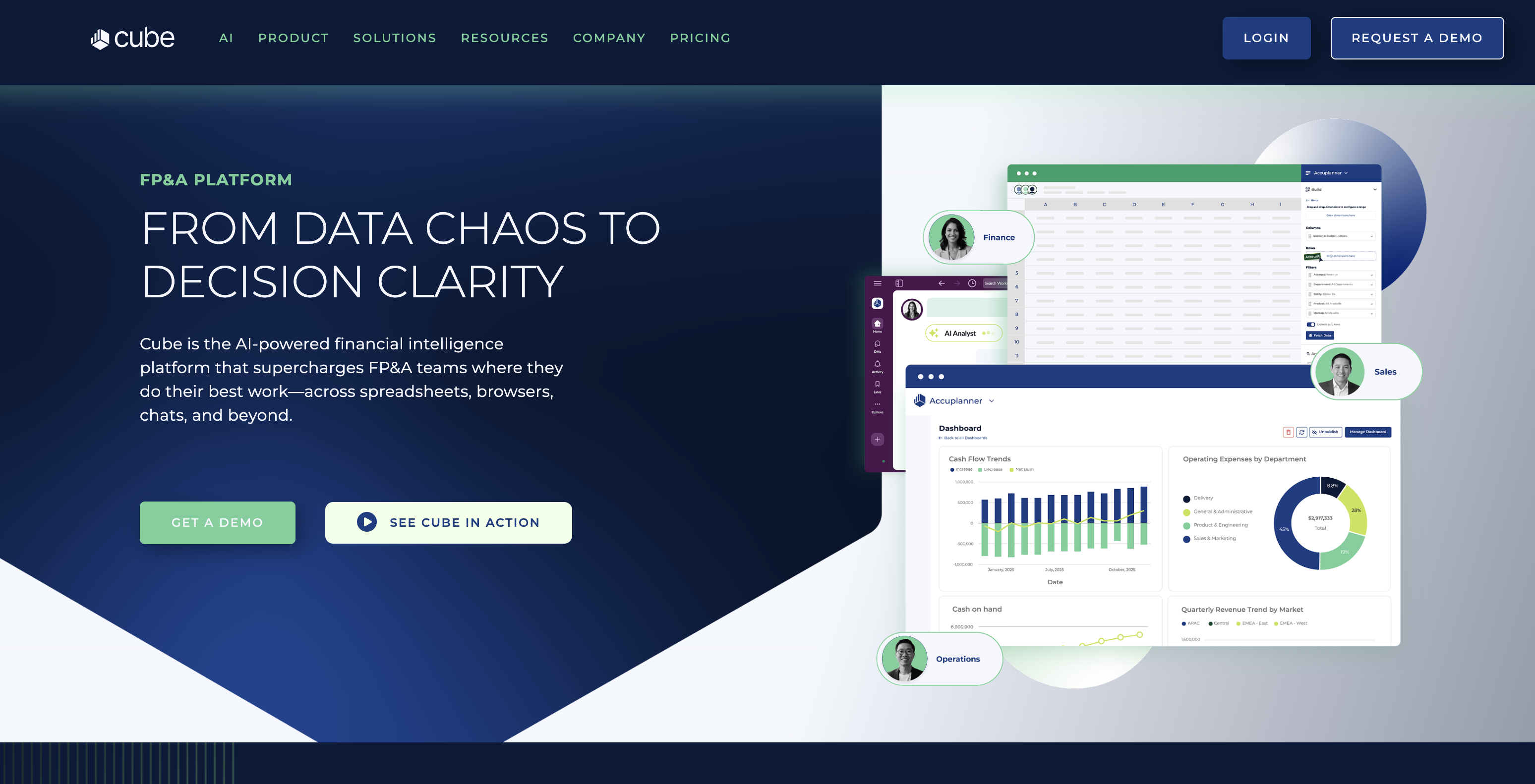
Specialization: AI-powered financial intelligence platform for FP&A teams
Founded by a 3x CFO, Cube is designed to eliminate the drudgery of financial planning and analysis. The platform connects your existing tools—Excel, Google Sheets, Slack, Teams—without disrupting workflows while adding intelligent data management capabilities.
Key Features:
- FP&Agents AI Suite: Purpose-built AI agents including The Strategist, The Planner, The Analyst, and The Data Manager
- No-Code Integration: Seamlessly connects spreadsheets, source systems, and teams
- 95% Workflow Time Reduction: Automated data gathering, validation, and anomaly detection
- Strategic Focus: Frees finance teams from reactive reporting to proactive strategy
Best For: Mid-market to enterprise FP&A teams seeking to eliminate manual spreadsheet work and shift focus to strategic finance
Pricing Impact: Users report saving $500K+ annually with mid-tier implementations
2. Ramp
Category: Corporate Expense Management & Cards
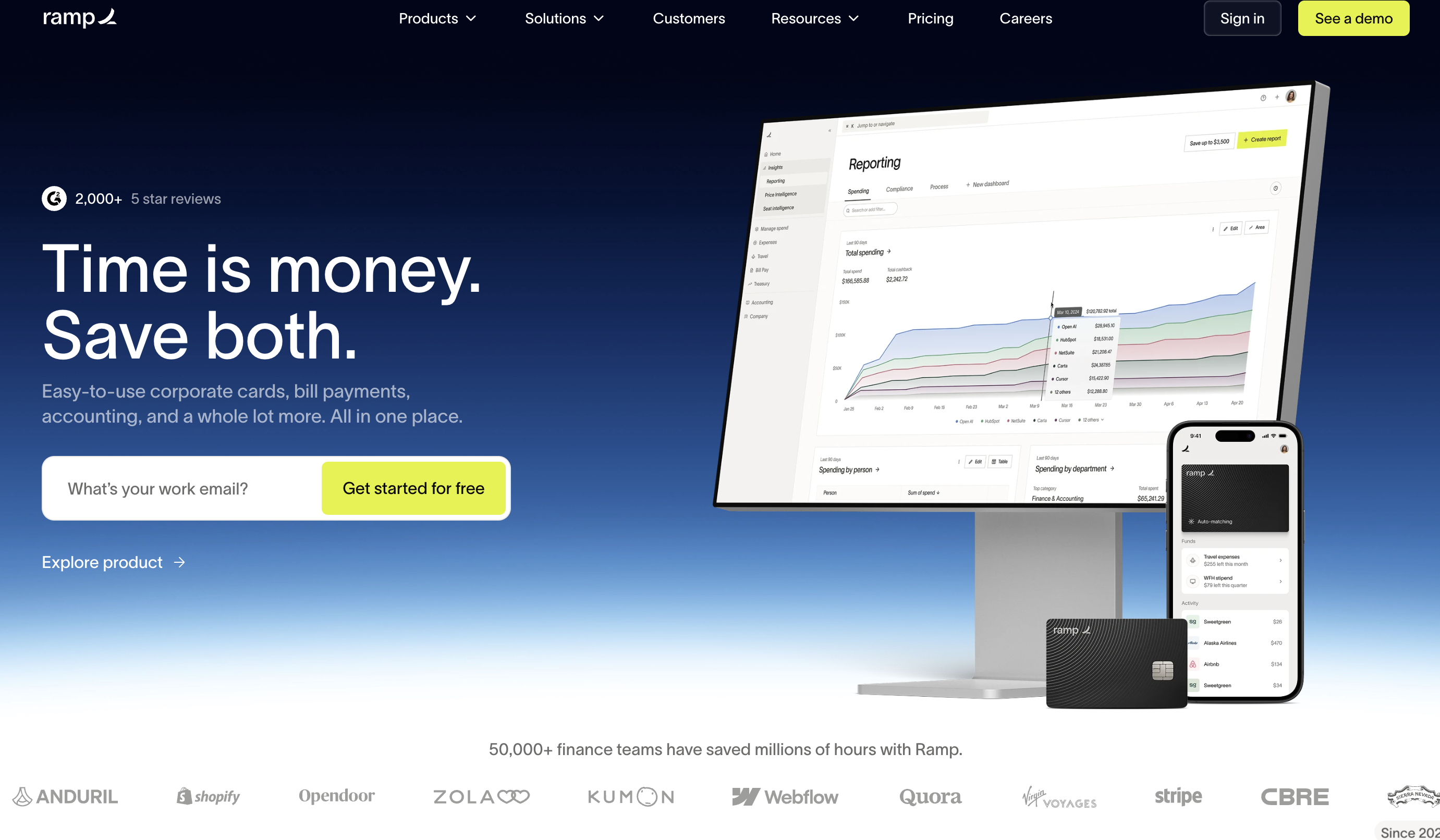
Specialization: AI-powered spend management platform
Ramp recently secured $500M in funding (July 2025) at a $22.5B valuation to accelerate AI development. The platform automates expense approvals, policy enforcement, and financial operations that traditionally require hours of human intervention.
Key Features:
- Ramp Intelligence: AI agents that automatically extract, categorize, and code every expense perfectly
- Automated Approvals: 85% fewer manual reviews with AI handling routine approvals
- Policy Enforcement: Detects 15x more policy violations than manual processes
- Smart Optimization: Automatically rebooks hotels if prices drop $50+ after booking
- SMS Assistance: Employees can submit and track expenses via text
Best For: Growing businesses and enterprises seeking to eliminate expense management busywork
Performance Metrics: Teams achieve 3x productivity compared to two years ago, with targets for 30x increase by 2027
Pricing: Corporate card and spend management platform (contact for pricing)
3. Docyt

Category: AI Accounting Automation
Specialization: High Precision Accounting Intelligence (HpAI)
Docyt has launched next-generation AI specifically built for accounting automation, utilizing 128 billion data points across 20+ industry sectors. The platform delivers end-to-end automation for bookkeeping, reconciliation, and financial reporting.
Key Features:
- 80% Auto-Categorization: Precision AI automatically categorizes majority of transactions
- Generative AI for Edge Cases: Handles the remaining 20% that typically need human review
- Multi-Model Approach: Blends fine-tuned LLMs, micro AI models, predictive AI, and NLP
- Real-Time Visibility: Instant financial reports and KPI dashboards
- Month-End Close Automation: Automated reconciliation, analytics, and anomaly flagging
Best For: Hospitality businesses, accounting firms managing multiple clients, and businesses requiring industry-specific accounting
Key Capabilities:
- Bill pay and vendor payment automation
- Credit card reconciliation
- Expense reports and reimbursements
- Revenue reconciliation with automated transaction matching
4. Copilot Money

Category: Personal Finance & Budgeting
Specialization: AI-enhanced personal finance for iPhone, Mac, and iPad
Named an Apple Editor’s Choice app and 2024 Apple Design Award Finalist, Copilot Money uses machine learning to make personal finance genuinely simple. The platform learns spending patterns and automatically categorizes every transaction.
Key Features:
- Adaptive Budgets: AI creates and adjusts realistic budgets based on your actual habits
- Smart Categorization: Machine learning tags transactions automatically, improving over time
- Conversational AI: Ask questions and set goals through natural language interface
- Subscription Tracking: Identifies and monitors all recurring subscriptions
- Privacy-First: No ads, no credit card promotions, no data selling
Best For: Individuals seeking elegant, intelligent personal finance management on Apple devices
Pricing: $95/year (or $14.99/month)
Why It Stands Out: Elegant interface combined with powerful AI that truly understands your financial patterns
5. Monarch Money

Category: Personal Finance & Budgeting
Specialization: AI-powered personal finance platform
Recognized by Wall Street Journal as “Best Budgeting App,” Forbes as “Best Mint Replacement,” and Motley Fool as “Best for Couples and Families.” Monarch’s Winter 2026 release introduced a comprehensive AI Assistant that knows your complete financial picture.
Key Features:
- AI Financial Assistant: Functions like a personal CFO who understands your entire financial situation
- Automatic Categorization: Machine learning categorizes all spending based on past behavior
- Receipt Scanning: Capture and organize receipts automatically
- Equity Tracking: Monitor investments and net worth in real-time
- Goal Management: AI-powered goal setting and progress tracking
Best For: Individuals and families seeking comprehensive personal finance management with AI guidance
Pricing: $99.99/year (approximately $8.33/month), or $14.99/month
Recognition: Multiple industry awards for user experience and functionality
6. Brex

Category: Corporate Expense Management & Cards
Specialization: AI-powered business spend management
Brex combines corporate cards, expense management, travel, business accounts, and bill pay into one intelligent platform. Recently partnered with Fifth Third Bank to power commercial card issuance with agentic AI.
Key Features:
- Intelligent Finance: AI eliminates manual expense reports, reviews, and policy enforcement
- Automated Approval: AI reviews and approves in-policy expenses while flagging anomalies
- 75% Automation Rate: Three-quarters of expenses prepared entirely with AI
- Mobile AI Assistant: Employees access expense assistance through the Brex app
- 40 Hours Saved Weekly: Users report significant time savings on expense reconciliation
Best For: Startups and growing businesses seeking complete spend management with corporate cards
Pricing:
- Essentials: Free (includes global cards, reimbursements, travel, accounting integrations)
- Premium: $12/user/month (custom roles, advanced integrations, live budgets)
7. Booke AI
Category: Bookkeeping Automation
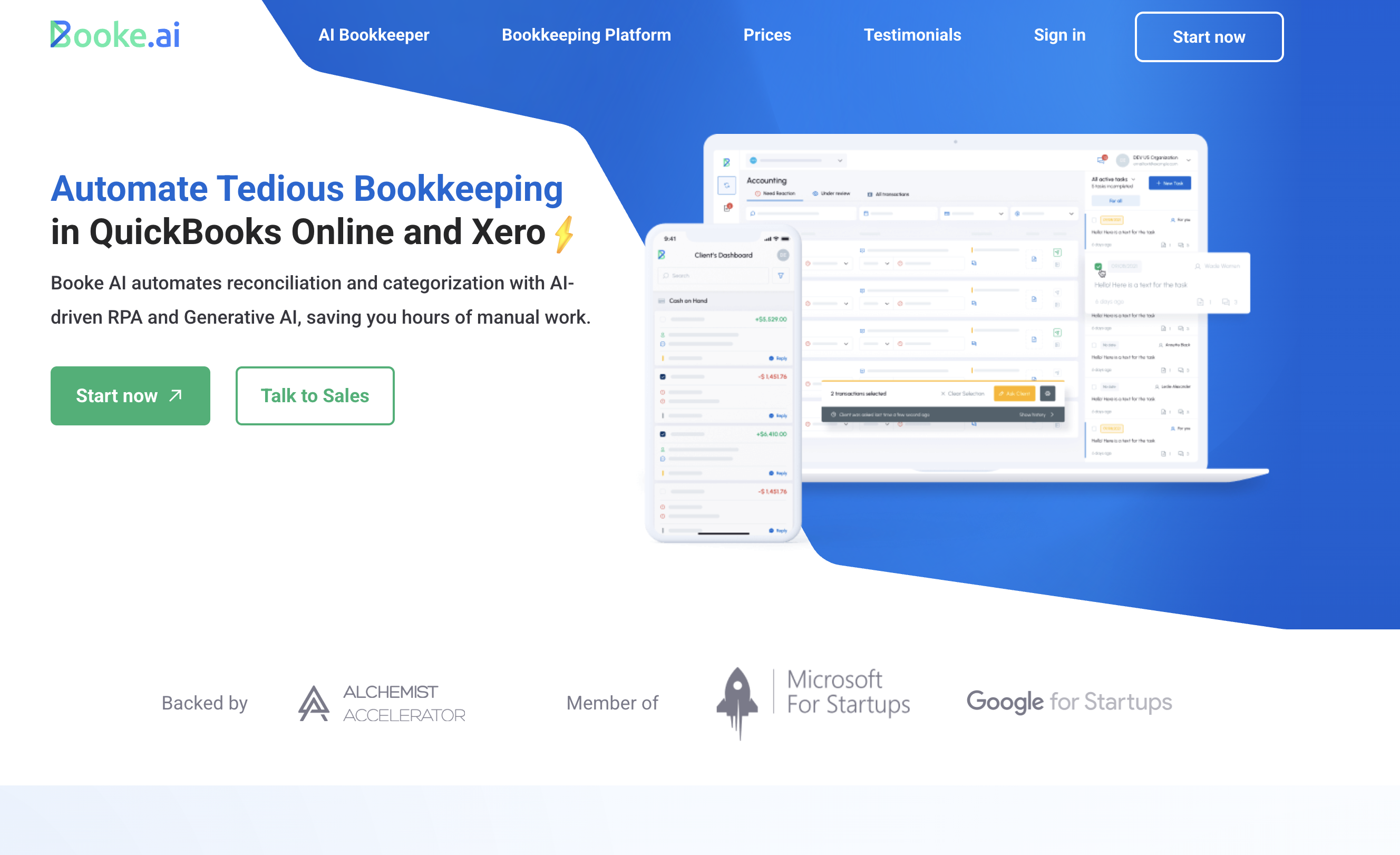
Specialization: RPA-driven AI bookkeeper for QuickBooks and Xero
Booke AI brings robotic process automation to bookkeeping with a first-in-market “Chain-of-Thought” AI approach that achieves up to 98% categorization accuracy by allowing AI to “think out loud” about each transaction.
Key Features:
- Robotic AI Bookkeeper: Automated categorization, matching, and platform syncing
- 98% Accuracy: Chain-of-Thought AI ensures precise classification
- 80% Faster Categorization: AI learns from each interaction to improve continuously
- Multi-Language OCR: Reads invoices and receipts in any language or currency
- Error Detection: Monitors for duplicates and unusual amounts before they become problems
- Client Portal: Streamlined communication reduces email back-and-forth
Best For: Accounting firms managing multiple clients, small business bookkeepers
Integration: Seamless QuickBooks Online and Xero integration with customizable frequency (daily, weekly, monthly)
Unique Advantage: Transparent AI reasoning process allows bookkeepers to understand and verify AI decisions
8. Xero

Category: Small Business Accounting
Specialization: Cloud accounting with AI-powered analytics
Xero has enhanced its cloud accounting platform with Analytics Plus, which uses AI to help small businesses manage financial operations and predict future cash flow through intelligent budgeting.
Key Features:
- AI-Powered Analytics Plus: Creates budgets by predicting future cash flow from historical data
- Automated Bank Reconciliation: Intelligent matching of bank transactions
- Expense Claims: Mobile receipt capture and automated expense processing
- Inventory Management: AI-assisted stock level optimization
- Multi-Currency: Automated exchange rate handling and foreign currency accounting
Best For: Small to medium businesses seeking comprehensive accounting with AI insights
Ecosystem: Extensive app marketplace for integration with 1,000+ business tools
Recognition: Trusted by millions of small businesses globally with strong accountant partnership network
How to Choose the Right AI Finance Tool
With so many powerful options available, selecting the right AI finance tool requires a strategic approach:
Step 1: Define Your Needs
For Personal Finance:
- Do you need budgeting, investment tracking, or both?
- What devices do you primarily use (iOS, Android, desktop)?
- How important is data privacy versus feature richness?
- What’s your budget for subscription tools?
For Business Finance:
- What’s your primary pain point (bookkeeping, expense management, FP&A)?
- How many team members need access?
- What accounting platforms do you currently use?
- What’s your monthly expense volume?
Step 2: Evaluate Integration Requirements
Critical Questions:
- Does it integrate with your existing accounting system?
- Can it connect to all your bank accounts and credit cards?
- Does it work with your ERP or business management tools?
- Will it sync with your team collaboration platforms?
Step 3: Assess AI Capabilities
Look for:
- Learning Ability: Does the AI improve as it learns your patterns?
- Accuracy Rates: What percentage of transactions are automatically categorized correctly?
- Automation Depth: How much manual work is truly eliminated?
- Explainability: Can you understand why the AI made certain decisions?
Step 4: Consider Scalability
Future-Proof Questions:
- Can the tool grow with your business?
- Is pricing based on usage, users, or flat rate?
- What happens to your data if you outgrow the platform?
- Does it support multiple entities, currencies, or locations?
Step 5: Test User Experience
Evaluate:
- Interface Design: Is it intuitive or require extensive training?
- Mobile Experience: Can you manage finances on the go?
- Speed: Are insights available in real-time?
- Support: What level of customer support is included?
Implementation Best Practices
Once you’ve selected your AI finance tool, follow these practices for successful adoption:
Week 1-2: Setup and Integration
Initial Configuration:
- Connect all relevant bank accounts and credit cards
- Import historical transactions (typically 3-6 months)
- Set up chart of accounts or budget categories
- Define approval workflows and policies
- Invite team members and assign roles
AI Training:
- Review initial categorizations and correct as needed
- The more accurate your corrections, the faster AI learns
- Set up custom rules for recurring transactions
- Configure alerts and notification preferences
Week 3-4: Team Onboarding
Training Focus:
- How to submit expenses through mobile apps
- Using conversational AI for financial queries
- Understanding AI-generated insights and reports
- When to override AI recommendations
Best Practices:
- Start with a pilot group before full rollout
- Gather feedback and adjust workflows
- Create internal documentation for common scenarios
- Celebrate early wins to build momentum
Month 2-3: Optimization
Fine-Tuning:
- Analyze which automations are working well
- Identify remaining manual bottlenecks
- Adjust AI confidence thresholds for approvals
- Refine budget categories and forecasting parameters
Measurement:
- Track time saved on financial tasks
- Monitor accuracy rates and exception handling
- Calculate ROI based on labor savings
- Survey user satisfaction and adoption rates
Ongoing: Continuous Improvement
Regular Reviews:
- Monthly audit of AI categorization accuracy
- Quarterly review of automated workflows
- Annual assessment of feature utilization
- Stay updated on new AI capabilities and features
Common Pitfalls to Avoid
1. Poor Data Quality at Start
Problem: Importing messy historical data confuses AI learning Solution: Clean and categorize at least one month of transactions manually before full automation
2. Insufficient AI Training
Problem: Accepting default categorizations without review Solution: Dedicate time in first month to actively train AI with corrections
3. Over-Automation Too Quickly
Problem: Turning on all automations without understanding workflows Solution: Enable features gradually, mastering each before adding more
4. Ignoring Team Adoption
Problem: Forcing tool usage without proper training or buy-in Solution: Involve end-users in selection process and provide comprehensive onboarding
5. Not Leveraging Full Capabilities
Problem: Using AI tools as expensive replacements for basic spreadsheets Solution: Regularly explore new features and AI capabilities as they’re released
The Future of AI Finance Tools
As we move through 2026 and beyond, several trends are shaping the next generation of AI finance tools:
Agentic AI Financial AI agents will handle increasingly complex workflows autonomously, from vendor negotiations to strategic financial planning. Expect AI that proactively identifies savings opportunities and executes approved actions.
Voice-First Interfaces Natural language processing will enable complete financial management through voice commands, making financial data accessible anywhere, anytime.
Predictive Compliance AI will anticipate regulatory changes and proactively adjust financial processes to maintain compliance, especially critical in evolving crypto and digital asset regulations.
Hyper-Personalization Machine learning models will create truly personalized financial strategies based on individual behavior patterns, life goals, and risk tolerances.
Embedded Finance AI finance capabilities will become embedded in industry-specific platforms, providing context-aware financial management within existing workflows.
Conclusion: Embracing AI for Financial Excellence
AI finance tools have evolved from experimental add-ons to essential infrastructure for modern financial management. Whether you’re tracking personal expenses, managing a growing startup, or overseeing enterprise financial operations, AI-powered tools offer unprecedented capabilities to:
Transform Operations:
✅ Eliminate 75%+ of manual financial work - Automated categorization, reconciliation, and reporting free your team for strategic analysis ✅ Achieve 95%+ accuracy rates - AI precision reduces errors and catches anomalies before they become costly problems ✅ Save 40+ hours weekly - Automation handles routine tasks that previously consumed days of labor ✅ Generate real-time insights - Instant visibility into financial health enables proactive decision-making ✅ Scale without proportional cost - AI handles increased volume without requiring headcount growth ✅ Predict with confidence - Machine learning forecasts based on billions of data points improve strategic planning
The tools highlighted in this guide—from Cube’s FP&A intelligence to Ramp’s expense automation, from Copilot’s personal finance AI to Docyt’s accounting automation—represent the cutting edge of financial technology in 2026. Each offers unique capabilities tailored to specific needs, but all share a common goal: making financial management more intelligent, efficient, and strategic.
The question is no longer whether to adopt AI finance tools, but which ones align best with your specific needs and how quickly you can implement them to gain competitive advantage.
Next Steps
Ready to transform your financial management with AI? Here’s your action plan:
- Identify your biggest pain point - Determine which financial process consumes the most time or causes the most errors (1 hour)
- Shortlist 2-3 tools from this guide that address your specific need and budget (2-3 hours)
- Request demos and trials - Most platforms offer free trials or demo accounts (1 week)
- Run a pilot with a small team or subset of data to validate the value (2-4 weeks)
- Measure the impact - Track time saved, accuracy improvements, and team satisfaction (ongoing)
- Scale gradually - Roll out to full team once pilot proves successful (4-8 weeks)
Contact ClearPick for personalized recommendations on AI finance tools tailored to your specific business needs - completely free for you.
Last updated: December 23, 2025 | Read time: 10 minutes