
California stands at the epicenter of global technology innovation—home to Silicon Valley, a thriving LA tech scene, and emerging hubs in San Diego and Orange County. The state’s software development agencies benefit from unparalleled access to venture capital, world-class technical talent from Stanford, Berkeley, and Caltech, and proximity to tech giants that set industry standards.
Whether you’re launching a mobile app, building enterprise software, developing AI-powered solutions, or creating the next unicorn startup, California’s software agencies offer cutting-edge expertise across every technology stack and industry vertical.
We evaluated California’s diverse software development landscape—from San Francisco to San Diego—to bring you this definitive top 5 list. We assessed technical capabilities, client portfolios, industry specializations, Clutch ratings, and innovation leadership to identify the Golden State’s premier software development partners.
What Makes a Great California Software Agency?
Access to Cutting-Edge Technology and Talent
California agencies work at the forefront of technology innovation. They have first access to new frameworks, tools, and platforms emerging from tech giants headquartered nearby. Their developers often come from Google, Apple, Meta, and leading startups, bringing insider knowledge of scalable architecture, modern development practices, and emerging technologies like AI/ML, AR/VR, and blockchain.
Startup Mentality Meets Enterprise Execution
The best California agencies balance Silicon Valley’s move-fast startup culture with enterprise-grade delivery. They understand product-market fit, MVP development, and rapid iteration—while also knowing how to build secure, scalable, HIPAA-compliant systems for regulated industries. This versatility makes them ideal partners whether you’re pre-seed or Fortune 500.
Deep Industry Vertical Expertise
California’s diverse economy—from Hollywood entertainment to biotech to fintech—means local agencies develop specialized expertise. Need a healthcare app that integrates with Epic? A fintech platform handling millions in transactions? An entertainment streaming solution? California agencies have likely built similar products and understand industry-specific challenges, regulations, and user expectations.
Product Thinking Beyond Code
Top California agencies think like product companies, not just dev shops. They challenge assumptions, suggest better approaches, and focus on outcomes over outputs. Expect questions like “What’s the business goal?” and “How will we measure success?” before discussions about tech stack. This strategic product thinking often separates good agencies from great ones.
Network Effects and Partnership Ecosystem
California agencies are plugged into the tech ecosystem—they know VCs, have relationships with platform partners (AWS, Google Cloud, Salesforce), and can make introductions that help your business. This network access provides value beyond just writing code, especially for startups seeking funding or partnerships.
Top 5 California Software Development Agencies
1. ArcTouch
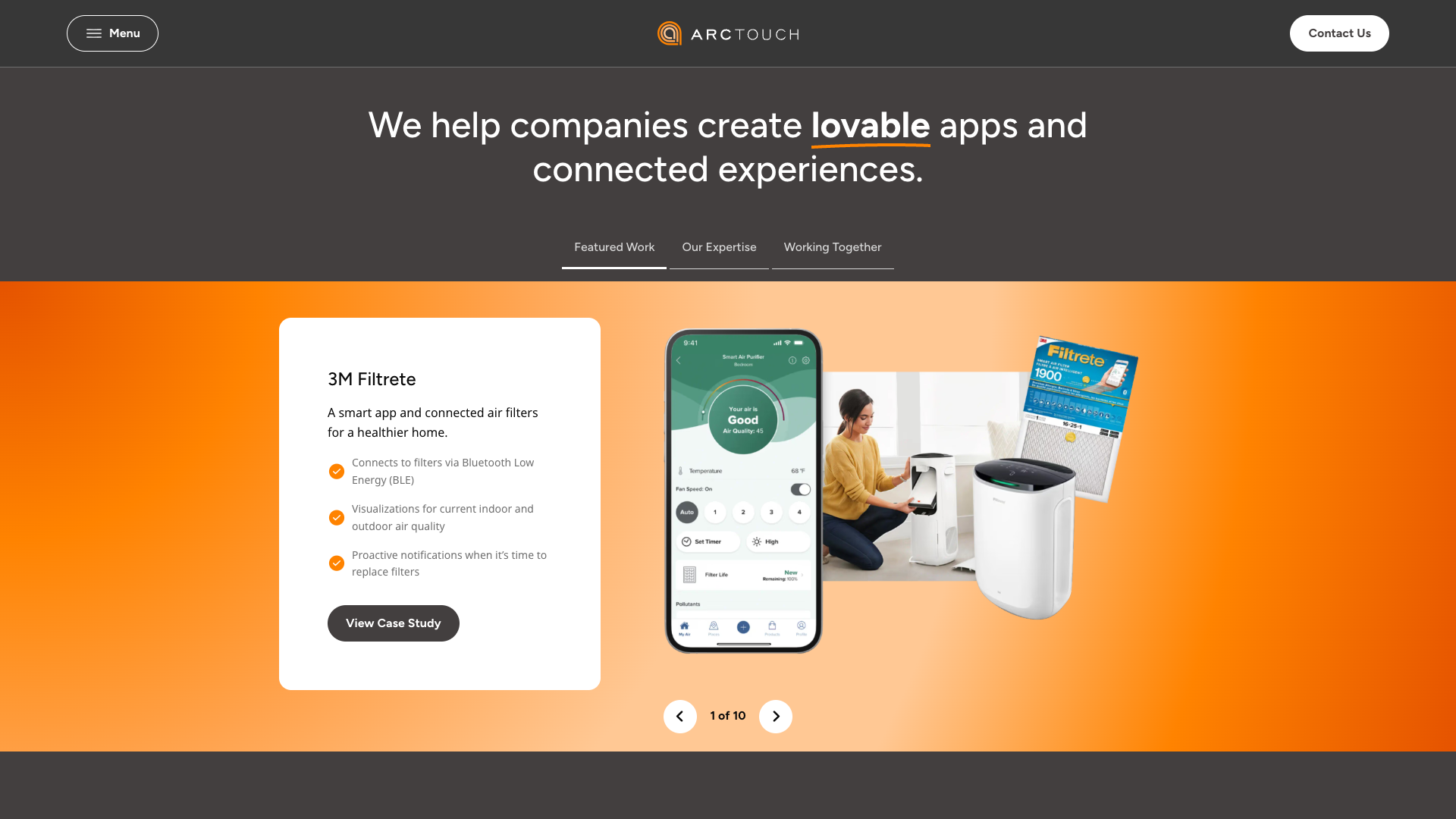
Website: arctouch.com
Location: 548 Market Street, San Francisco, CA 94104
Founded: 2008
Why They’re #1: ArcTouch has built over 500 “lovable apps” for the world’s most recognizable brands—Disney, Audi, Amazon, Walmart, and Salesforce. Acquired by WPP/Grey in 2016, they combine boutique-quality design and development with enterprise-scale resources. With 350+ professionals across 5 continents and projects ranging from $50K to $5M, ArcTouch handles everything from startup MVPs to global digital transformations.
Key Services:
- Mobile app development (iOS & Android native)
- Custom web application development
- UX/UI design and product strategy
- IoT and connected device development
- AI application development
- Enterprise web services and APIs
- Digital transformation consulting
Technology Stack: Swift, Objective-C, Java, Kotlin, React Native, AWS, Azure, Google Cloud, modern backend frameworks, API development
Industries Served:
- Media and entertainment
- Enterprise software
- Healthcare and medical devices
- Consumer applications
- IoT and connected devices
- Retail and e-commerce
Team Size: ~259 employees (350+ including WPP network)
Pricing:
- Hourly rate: $50-$99
- Minimum project: $100,000+
- Typical range: $50,000 to $5,000,000+
Best For: Enterprise companies and well-funded startups needing world-class mobile and web applications with proven UX excellence and the ability to scale globally.
Notable Achievements:
- 500+ apps created with focus on “lovable” user experiences
- Clients include Disney, Audi, Amazon, 3M, Hawaiian Airlines, CBS, Walmart, Salesforce, Adidas, HarperCollins, Merck
- Part of WPP/Grey network (acquired 2016)
- 37 verified reviews on Clutch
- Projects featured in App Store and Google Play top charts
- Strong track record in connected devices and IoT
- San Francisco headquarters with global delivery capabilities
2. Goji Labs
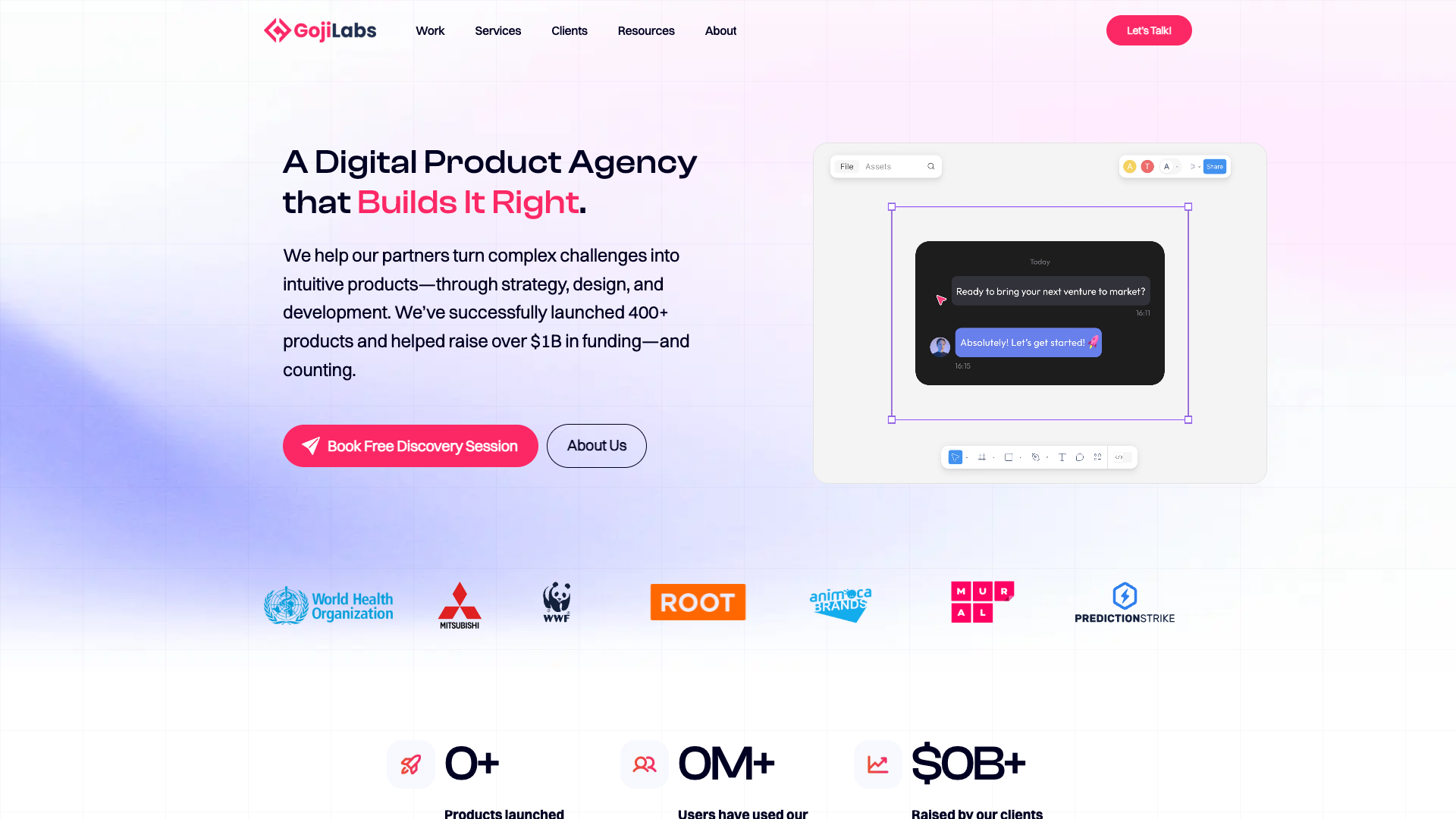
Website: gojilabs.com
Location: 800 Wilshire Blvd, Suite 200, Los Angeles, CA 90017
Founded: 2014
Why They’re #2: Goji Labs has helped clients raise over $500 million in funding by building products that investors and users love. With 83 five-star Clutch reviews and recognition on Inc. 5000 2024 and Clutch’s Top 100 Fastest-Growing Companies, this LA agency combines technical excellence with user-first design. They’ve built 400+ digital products in 10 years, offering 24-48 hour issue response times and a track record of successful exits and funding rounds.
Key Services:
- Product strategy and consulting
- UI/UX design and prototyping
- Mobile app development (iOS, Android, React Native, Flutter)
- Web application development
- Full-stack software development
- IoT development and connected devices
- Startup MVP development
Technology Stack:
- Frontend: React.js, Angular, modern JavaScript
- Backend: Node.js, Python, Django, Ruby on Rails, Golang
- Mobile: React Native, iOS (Swift), Android (Java), Flutter, Ionic
- Database: PostgreSQL, MongoDB, MySQL
- Cloud: AWS, Google Cloud, Azure
Industries Served:
- Healthcare and telehealth
- Social impact and nonprofit
- Education and EdTech
- Fintech and financial services
- Consumer apps
- Enterprise software
Team Size: 26-58 employees
Pricing:
- Hourly rate: $100-$149
- Minimum project: $25,000+
- Typical range: $10,000 to $600,000+
Best For: Startups and growth companies needing strategic product development, especially those seeking to raise funding or build social impact applications.
Notable Achievements:
- Helped clients raise $500M+ in funding
- Built 400+ digital products across 10 years
- 83 reviews on Clutch with 5-star rating
- Inc. 5000 list (2024)
- Clutch Top 100 Fastest-Growing Companies
- Notable clients: WHO, World Wildlife Fund, City of Los Angeles, UCLA, USC
- 24-48 hour issue response time commitment
- Strong focus on social impact and purpose-driven companies
3. Saritasa
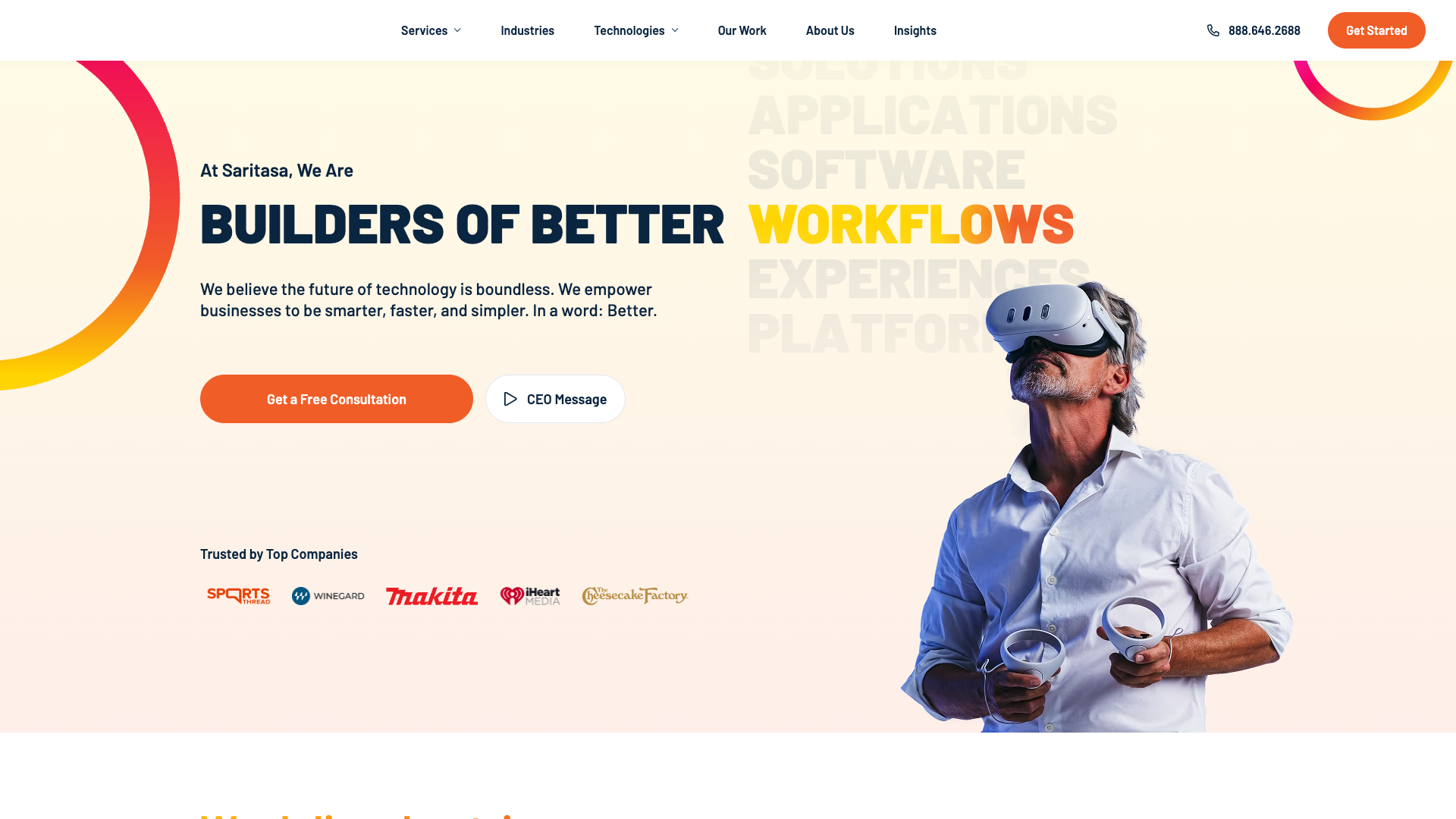
Website: saritasa.com
Location: Newport Beach, California (with offices in LA and other US cities)
Founded: 2005
Why They’re #3: With 20 years of experience and 1,700+ successful projects, Saritasa is California’s go-to agency for AR/VR development, healthcare software, and fintech solutions. Recognized as #1 Top VR/AR Developers and #1 Top Software Developers in California by Clutch, they’ve pioneered immersive experiences while maintaining deep expertise in HIPAA-compliant healthcare systems and financial platforms. Their 4.8/5 rating from 101 Clutch reviews reflects consistent quality across diverse industries.
Key Services:
- Custom software development
- Mobile app development (iOS, Android, React Native)
- Web development and progressive web apps
- AR/VR development (Oculus, HoloLens)
- IoT solutions and connected devices
- DevOps and cloud infrastructure
- Healthcare IT and HIPAA-compliant solutions
Technology Stack:
- Frontend: Angular, React, Figma
- Backend: PHP, Node.js, MySQL, Linux
- Mobile: iOS, Android, React Native
- Emerging Tech: AR/VR (Oculus, HoloLens), Bluetooth Low Energy, RFID
- Cloud: AWS, Azure, modern DevOps pipelines
Industries Served:
- Healthcare and medical devices
- Fintech and financial services
- Automotive and transportation
- Education and EdTech
- Construction and real estate
- Logistics and supply chain
- Insurance and legal
Team Size: 140+ employees
Pricing:
- Hourly rate: $100-$149
- Minimum project: $50,000+
- Offers reduced rates for nonprofit organizations
Best For: Companies building AR/VR experiences, healthcare applications requiring HIPAA compliance, or fintech platforms needing proven security and scalability.
Notable Achievements:
- 20 years in business (since 2005)
- 1,700+ successful projects delivered
- #1 Top VR/AR Developers (Clutch)
- #1 Top Software Developers in California (Clutch)
- Clutch 1000 (2024)
- 4.8/5 rating with 101 reviews on Clutch
- Clients include iHeartMedia, BJ’s Restaurant, Yamaha, Toyota, Sony, Verizon
- Pioneers in AR/VR with extensive portfolio
- Strong healthcare and fintech specialization
4. TATEEDA
Website: tateeda.com
Location: San Diego, California
Founded: 2012
Why They’re #4: TATEEDA is California’s premier healthcare software specialist, offering deep expertise in medical device software, telemedicine platforms, and HIPAA-compliant solutions. With 100+ engineers and integrations into major healthcare systems (Epic, Cerner, Optum, Waystar), they understand the complexity of healthcare IT better than generalist agencies. Named to Inc. 5000 three consecutive years (2022, 2023, 2024) and recognized for FDA-regulated medical device software, TATEEDA is the clear choice for life sciences and healthcare technology companies.
Key Services:
- Custom healthcare software development
- Medical device software (FDA-regulated)
- Telemedicine and telehealth platforms
- Healthcare IT consulting
- HIPAA-compliant application development
- Staff augmentation for healthcare projects
- Medical billing and claims processing systems
- EHR/FHIR integrations
Technology Stack:
- Frontend: Angular, React, Vue, jQuery, JavaScript, CSS3, Dart
- Backend: C#, .NET, Node.js, MySQL, PHP, TypeScript
- Mobile: React Native, Flutter, NativeScript
- Medical Device: C, C++, Python, MicroPython, Java
- Healthcare Integrations: Epic, Cerner, Salesforce Health Cloud, OpenAI, IBM Watson, Oracle Health, Waystar, Optum
Industries Served:
- Healthcare and hospitals
- Medical device manufacturers
- Biotech and life sciences
- Telemedicine providers
- Healthcare IT companies
- Clinical research organizations
Team Size: 100+ engineers (51 total employees across 3 continents)
Pricing:
- Hourly rate: $70-$150 (market average for healthcare specialization)
- Custom pricing based on project scope
Best For: Healthcare organizations, medical device companies, biotech firms, and life sciences companies needing HIPAA-compliant software with deep healthcare system integrations.
Notable Achievements:
- Inc. 5000 three consecutive years (2022, 2023, 2024)
- San Diego Business Journal Fastest Growing (5 consecutive years)
- Top Medical Software Developers (2023)
- Top Staff Augmentation Company (2023)
- 100+ healthcare engineers with specialized expertise
- FDA-regulated medical device software experience
- Deep integrations: Epic, Cerner, Oracle Health, Optum, Waystar
- HIPAA compliance expertise across all projects
- Client: La Maestra Community Health Centers and multiple healthcare tech providers
5. Azumo
Website: azumo.com
Location: 100 Broadway, San Francisco, California
Founded: 2016
Why They’re #5: Azumo is California’s fastest-growing AI/ML specialist, doubling in size annually since 2016. With expertise across 500+ AI models and frameworks—including LLaMA, Anthropic Claude, Databricks, and Haystack—they’re perfectly positioned for the AI revolution. Their 100% remote nearshore model delivers enterprise-quality AI development at startup-friendly pricing ($25-$70/hour), serving Fortune 100 companies while maintaining a 4.9/5 Clutch rating from 21 reviews.
Key Services:
- AI and machine learning development
- Generative AI and LLM integration
- Conversational AI and chatbots
- Web and mobile application development
- Data engineering and analytics
- DevOps and cloud infrastructure
- Enterprise software modernization
Technology Stack:
- AI/ML: Python, LLaMA, Anthropic Claude, Databricks, Haystack, 500+ AI models/frameworks
- Frontend: React, Next.js, JavaScript, TypeScript
- Backend: Node.js, Python, C#, Java
- Cloud: AWS, Azure (certified experts)
- DevOps: Modern CI/CD pipelines, containerization
Industries Served:
- Fintech and financial services
- Healthcare and medical technology
- Enterprise software
- Media and entertainment
- E-commerce and retail
Team Size: ~201 employees (100% remote nearshore model)
Pricing:
- Hourly rate: $25-$70 (varies by source; most affordable among top-tier agencies)
- Minimum project: $10,000+
- Typical range: $4,200 to $70,000+
Best For: Companies prioritizing AI/ML capabilities, data engineering, or needing enterprise-quality development at competitive rates through a nearshore model.
Notable Achievements:
- Doubled in size every year since 2016
- 4.9/5 stars on Clutch (21 reviews)
- Clutch Top Software Developers (2021)
- Expertise across 500+ AI models and frameworks
- Fortune 100 clients including Twitter, Facebook, Discovery Channel, NCSoft
- San Francisco headquarters with distributed nearshore team
- Strong focus on AI/GenAI, conversational AI, and data engineering
- AWS and Azure certified experts
- Most cost-effective hourly rate while maintaining high quality
Why Choose a California Software Agency?
Silicon Valley Innovation DNA
California agencies are immersed in the world’s most innovative technology ecosystem. They see emerging trends first, adopt new technologies faster, and understand what separates successful products from failed experiments. This innovation DNA—shaped by proximity to Google, Apple, Meta, and thousands of startups—translates to forward-thinking solutions that anticipate market shifts rather than react to them.
Access to World-Class Technical Talent
California attracts the best developers globally, drawn by tech giants, startup opportunities, and the state’s technology culture. Agencies recruit from Stanford, Berkeley, Caltech, and top coding bootcamps, while also hiring experienced engineers from FAANG companies seeking agency variety. This talent density means you’re working with developers who’ve built systems at massive scale or shipped products used by millions.
Product-Market Fit and Venture Capital Expertise
California agencies understand the startup journey because they’re surrounded by it. They know how to build MVPs that test hypotheses efficiently, pivot when data suggests a new direction, and scale when product-market fit is achieved. Many have helped clients raise funding by building products that impress investors—they understand what VCs look for and how to demonstrate traction.
Cutting-Edge Technology Adoption
California agencies adopt new technologies early because they’re often beta testing for companies creating those technologies. Need to build with the latest LLM, implement cutting-edge AR, or leverage new Apple/Google APIs? California agencies have likely already experimented with these technologies and can avoid costly mistakes that come with bleeding-edge adoption.
Entertainment, Healthcare, and Fintech Expertise
California’s economy spans entertainment (Hollywood), healthcare (biotech corridor), fintech (SF), and more—giving local agencies deep vertical expertise. Need streaming technology? Cannabis compliance software? Medical device integration? Cryptocurrency wallets? California agencies have built these products and understand industry nuances that generalist agencies miss.
How to Choose the Right California Software Agency
Step 1: Define Your Technical Vision and Business Goals
Be clear about what you’re building and why:
- Product type: Mobile app, web application, AI platform, IoT solution, AR/VR experience
- Stage: MVP/proof-of-concept, growth features, enterprise scale, modernization
- Business goal: Raise funding, acquire users, automate operations, enter new market
- Technical requirements: Specific integrations, compliance needs (HIPAA, SOC 2), performance targets
- Timeline: Launch deadline, funding runway, market window
Clear articulation helps agencies assess fit and provide relevant proposals.
Step 2: Assess Specialization Match
California agencies often specialize by industry or technology. Match your needs to their expertise:
- Healthcare: TATEEDA for medical software, Saritasa for HIPAA compliance
- AI/ML: Azumo for AI-first products and LLM integration
- Mobile: ArcTouch for consumer-grade app experiences
- Startups: Goji Labs for MVP and funding readiness
- AR/VR: Saritasa for immersive experiences
- Enterprise: ArcTouch or Azumo for scalable platforms
Review case studies in your specific area—generalists may claim capability, but specialists have battle-tested solutions.
Step 3: Evaluate Portfolio Quality and Relevant Experience
Don’t just count projects—assess relevance and outcomes. Look for:
- Similar technical challenges: Have they built with your required stack or integrations?
- Similar scale: User volume, transaction volume, data complexity
- Visual quality: Does their design work match your brand ambitions?
- Business results: Do case studies cite metrics (downloads, revenue, funding)?
- Recent work: Agencies evolve—ensure recent portfolio reflects current capabilities
Ask to speak with references from projects similar to yours in complexity and industry.
Step 4: Understand Development Process and Communication Style
California agencies range from highly structured to agile and flexible. Ensure alignment on:
- Methodology: Scrum, Kanban, shape-up, or hybrid approaches
- Sprint cadence: Weekly demos, bi-weekly sprints, monthly milestones
- Communication: Daily standups, Slack availability, async updates
- Tools: Jira, Linear, Notion, Figma, GitHub—what they use for transparency
- Involvement expected: How much time you’ll need to invest for feedback and decisions
Misaligned process expectations cause more friction than technical disagreements.
Step 5: Consider Remote vs. Local Collaboration
California’s high cost of living has pushed many agencies toward remote models:
- SF-based with remote teams: Azumo (nearshore), others with distributed developers
- Hybrid: Some agencies maintain offices but work remotely
- Full on-site: Rare and expensive, but available for sensitive projects
Decide if you value:
- Face-to-face: In-person workshops, whiteboarding, relationship building
- Cost savings: Remote/nearshore models typically 20-40% less expensive
- Flexibility: Remote agencies often provide extended hour coverage
Most California agencies now excel at remote delivery—COVID proved effectiveness.
Step 6: Compare Pricing Models and Budget Alignment
California pricing varies widely ($25-$150+/hour) based on:
- Location: SF/Silicon Valley most expensive, San Diego/OC more moderate
- Model: Onshore (high), nearshore (medium), offshore (low)
- Specialization: Healthcare, AI/ML, AR/VR command premium rates
- Scale: Larger agencies have higher overhead but more resources
Pricing models:
- Time & materials: $70-$150/hour typically, flexible scope
- Fixed price: $50K-$500K+ depending on scope, less flexibility
- Retainer: $20K-$100K/month for ongoing development
- Equity: Some agencies take equity for startups (less common)
Get detailed proposals comparing total cost, timeline, and what’s included (design, QA, deployment, etc.).
Step 7: Verify Technical Depth and Team Composition
Don’t get sold by business development—meet the actual team. Ask:
- “Who specifically will work on my project?” (names, roles, seniority)
- “What’s their experience with [your tech stack or industry]?”
- “Will team members be dedicated or shared across projects?”
- “How do you handle knowledge transfer if someone leaves?”
- “Can I interview proposed developers before committing?”
Some agencies staff with junior developers after selling with senior talent. Get team commitments in contracts.
Red Flags to Avoid When Hiring California Software Agencies
Overpromising on Timeline Without Discovery
Red flag: “We can build your marketplace app in 8 weeks” before understanding requirements, integrations, or technical complexity
Reality: Quality software requires proper discovery, design, iterative development, testing, and refinement. Agencies promising unrealistic timelines will cut corners, ship bugs, or miss deadlines. Expect 3-6 months for moderate complexity projects.
Vague About Team Location or Offshore Partners
Red flag: California agency charges $150/hour but is vague about where developers are located or mentions “global team” without transparency
Reality: Many California agencies use offshore development. This isn’t inherently bad, but lack of disclosure is concerning. You should know where your team works, what time zones they’re in, and how communication will flow.
Portfolio Doesn’t Match Your Needs
Red flag: Agency shows beautiful consumer apps but you need HIPAA-compliant healthcare software, or they show enterprise work but you’re a bootstrap startup
Reality: Different projects require different mindsets. Enterprise agencies may overbuild and overcharge for MVP. Consumer agencies may not understand healthcare compliance. Ensure their experience matches your specific needs, not just “software development” broadly.
No Technical Leadership in Initial Conversations
Red flag: Only sales/business development people involved in scoping, no technical leaders asking probing questions about architecture, integrations, or scale
Reality: Great agencies involve technical leaders early to assess feasibility, spot potential issues, and architect appropriate solutions. If you only meet salespeople until after signing, expect misalignment between sold vision and technical reality.
Intellectual Property Terms Favor Agency
Red flag: Contract language suggests agency retains rights to code, or owns reusable components built specifically for your project
Reality: You should own all custom code and deliverables created specifically for you. Agencies may retain rights to their internal tools/frameworks (reasonable), but your product code should be 100% yours. Review IP clauses carefully with legal counsel.
No Post-Launch Support Plan or Monitoring
Red flag: Agency focused entirely on launch, with no discussion of monitoring, bug fixes, optimization, or ongoing support
Reality: Launch is the beginning, not the end. Software requires monitoring, bug fixes, performance optimization, and feature evolution. Discuss support plans, response SLAs, and ongoing partnership expectations before signing.
Pricing Expectations for California Software Agencies
Startup MVP Projects ($25,000 - $100,000)
Scope: Minimum viable product, mobile app MVP, basic web application, proof-of-concept
Examples:
- Mobile app MVP with 5-8 core screens
- Web application with user authentication and basic features
- API integration and simple backend
- Basic admin dashboard
Timeline: 2-4 months
Best for: Pre-seed to seed-stage startups, entrepreneurs testing product-market fit, companies validating ideas before major investment
Agencies: Goji Labs ($25K min), Azumo ($10K min)
Growth Stage Projects ($100,000 - $300,000)
Scope: Full-featured applications, mobile + web platforms, moderate complexity integrations
Examples:
- Consumer mobile app with social features and backend
- E-commerce platform with payment integration
- Healthcare app with basic HIPAA compliance
- Data dashboard with analytics and reporting
- IoT solution with device connectivity
Timeline: 4-8 months
Best for: Series A/B startups, established small businesses, companies scaling proven products
Agencies: ArcTouch ($100K min), Goji Labs, Saritasa ($50K min), Azumo
Enterprise & Complex Projects ($300,000 - $1,000,000+)
Scope: Enterprise platforms, multi-platform solutions, legacy modernization, complex compliance
Examples:
- Enterprise SaaS platform (web + iOS + Android)
- Healthcare platform with Epic/Cerner integration
- Fintech solution with banking integrations
- AR/VR immersive experience
- AI-powered platform with ML models
- Legacy system modernization
Timeline: 8-18 months
Best for: Series C+ startups, mid-market to enterprise companies, regulated industries
Agencies: ArcTouch (up to $5M), Saritasa, TATEEDA (healthcare), Azumo (AI/ML)
Specialized High-Value Projects
AR/VR Development: $100,000 - $500,000+ (Saritasa) Medical Device Software: $150,000 - $1,000,000+ (TATEEDA) AI/ML Platforms: $75,000 - $500,000+ (Azumo)
Ongoing Development Retainers
California agencies offer ongoing partnerships for continuous development:
- Startup retainer: $15,000-$40,000/month (small dedicated team)
- Growth stage retainer: $40,000-$100,000/month (full team with PM, designers, devs)
- Enterprise retainer: $100,000-$200,000+/month (multiple teams, strategic partnership)
Best for: Companies with continuous product evolution, regular feature releases, or ongoing technical needs
Conclusion
California’s software development agencies represent the pinnacle of technical innovation, combining Silicon Valley’s startup culture with enterprise-grade execution. From ArcTouch’s 500+ lovable apps to Azumo’s AI/ML expertise, each agency on this list brings unique strengths shaped by California’s diverse technology ecosystem.
When choosing your California software partner, prioritize agencies with:
- ✅ Proven experience in your specific industry or technology
- ✅ Portfolio demonstrating quality and scale matching your ambitions
- ✅ Transparent pricing and realistic timeline estimates
- ✅ Strong client references with measurable outcomes
- ✅ Technical leadership involvement from day one
Remember that the cheapest option rarely delivers the best value. California agencies charge premium rates because they deliver premium outcomes—products that raise funding, win users, and scale successfully. The right agency becomes a strategic partner invested in your success, not just a vendor delivering code.
Next Steps
Ready to find your ideal California software development partner?
- Define your vision: Document product goals, target users, and success metrics
- Determine budget: Allocate realistic budget based on project complexity ($50K-$500K+ typical)
- Identify specialization needs: AI/ML, healthcare, mobile-first, enterprise, etc.
- Shortlist 3-4 agencies: Select based on relevant portfolio and specialization match
- Request detailed proposals: Share requirements and compare technical approaches
- Check references: Speak with past clients about delivery, communication, quality
- Meet the actual team: Ensure developers (not just salespeople) will work on your project
- Start with discovery: Many agencies offer paid discovery phases ($10K-$25K) to validate approach before committing to full development
For additional guidance on software development, explore our related articles on mobile app development, AI integration strategies, and digital transformation best practices.
Last updated: December 16, 2025