
How to Choose a Marketing Agency in 2026: Complete Guide to Finding Your Perfect Partner
The marketing landscape has fundamentally transformed. What worked in 2024—or even six months ago—may no longer drive results. With AI automating creative production, conversational search replacing keyword queries, privacy regulations eliminating third-party cookies, and new platforms emerging constantly, marketing has become exponentially more complex.
Global advertising spend is projected to reach $1.16 trillion in 2025, with digital channels accounting for 74.4% of total spend according to DataReportal’s Digital 2026 Global Overview Report. Yet 83% of marketers cite proving ROI as their top challenge. The stakes have never been higher—and the penalties for choosing the wrong marketing partner have never been more severe.
This comprehensive guide will walk you through everything you need to know to select the right marketing agency in 2026. Whether you’re a startup seeking rapid growth, a mid-market company scaling operations, or an enterprise optimizing sophisticated campaigns, the agency you choose will directly impact your customer acquisition costs, revenue growth, and competitive positioning.
Why Agency Selection Matters More Than Ever in 2026
The marketing agency landscape has evolved dramatically:
Technology Complexity: The average marketing team uses dozens of tools spanning analytics, automation, content creation, social media, advertising platforms, and CRM systems. Gartner research found that martech accounts for 25.4% of marketing budgets, yet only 49% of tools are actively used. Agencies must navigate this complexity while avoiding tool bloat.
AI Integration: 92% of companies plan to increase AI investments, with 86% of advertisers already using or planning to use generative AI for video ad production according to Search Engine Journal’s 2026 Marketing Trends. Meta aims to fully automate advertising with AI by the end of 2026. Agencies that cannot leverage AI effectively will fall behind.
Privacy-First Data: Third-party cookies are disappearing, forcing a fundamental shift to first-party data strategies. Brands must build their own “data spine” through customer data platforms, conversion APIs, and value-added experiences that earn consent.
Platform Proliferation: With 6.04 billion internet users engaging with an average of 6.75 different platforms monthly, marketers must orchestrate cohesive experiences across fragmented touchpoints. TikTok, LinkedIn, YouTube, Instagram, emerging platforms—each requires unique content and strategy.
Measurement Evolution: Traditional attribution is collapsing under privacy constraints. Marketing mix modeling (MMM) and incrementality testing are replacing last-click attribution, requiring sophisticated analytical capabilities.
Outcome Pressure: CFOs and boards demand measurable business outcomes—not vanity metrics. Customer acquisition cost (CAC), lifetime value (LTV), return on ad spend (ROAS), and revenue attribution must be tracked rigorously.
In this environment, the right agency partner becomes a strategic advisor and execution powerhouse. The wrong partner wastes budget, misses opportunities, and puts you at competitive disadvantage.
Key Factors to Consider When Choosing a Marketing Agency
1. Strategic Alignment & Expertise
The agency must understand not just marketing tactics but your business model, competitive landscape, and growth objectives.
What to Look For:
- Track record in your industry or with similar business models
- Strategic thinking beyond execution (they should challenge your assumptions)
- Understanding of your customer journey and decision-making process
- Ability to translate business goals into marketing strategies
- Experience at your company’s stage (startup vs. growth vs. mature)
Red Flags:
- Cookie-cutter approaches applied to every client
- Focus on tactics before understanding strategy
- Inability to articulate how marketing drives business outcomes
- No questions about your business model or customers
2. Core Competencies for 2026
Marketing in 2026 requires capabilities that didn’t exist—or weren’t essential—just a few years ago.
Must-Have Capabilities:
AI & Automation Proficiency: The agency should leverage AI for content creation, campaign optimization, audience targeting, and performance analysis. Ask how they use AI tools and what proprietary capabilities they’ve developed.
Answer Engine Optimization (AEO): With Google AI Overviews and conversational search changing the game, agencies must understand how to optimize for featured snippets, voice queries, and AI-generated responses. Smart Insights’ Digital Marketing Trends 2026 notes a 24% drop in organic clicks when AI Overviews appear—agencies must adapt strategies accordingly.
Full-Funnel Execution: Siloed channel expertise is insufficient. The agency should integrate SEO, PPC, social media, content marketing, email, and retargeting into cohesive customer journeys. According to HubSpot’s State of Marketing Report, 35% of marketers use AI for content creation and 30% for data analysis—these capabilities must work together across the funnel.
Analytics & Attribution Mastery: Deep expertise in Google Analytics 4, conversion tracking, marketing mix modeling, and incrementality testing. The ability to connect marketing activities to revenue outcomes.
First-Party Data Strategies: Building customer data platforms, implementing conversion APIs, creating value exchanges for consent, and activating first-party data across channels.
Video & Creative Production: With 89% of consumers wanting more video from brands and 83% preferring video over text for educational content (per MarketingProfs research), video creation at scale is essential.
3. Cultural Fit & Collaboration Style
You’ll work closely with your agency for months or years. Cultural alignment determines whether the partnership thrives or creates friction.
Assess:
- Communication style (formal vs. casual, data-driven vs. intuitive)
- Decision-making approach (collaborative vs. directive)
- Transparency in reporting and methodology
- Responsiveness and availability
- Values alignment (sustainability, diversity, ethics)
During Discovery:
- How do they interact in meetings? Do they listen or just pitch?
- Are they asking thoughtful questions about your business?
- Do team members seem engaged and knowledgeable?
- Does their work environment and culture resonate with you?
4. Scalability & Innovation
Choose an agency that can grow with you and stay ahead of trends.
Scalability Indicators:
- Experience managing budgets at your current and target scale
- Ability to add services as needs expand
- Team depth (not dependent on one or two people)
- Technology infrastructure to handle growth
- Process documentation and knowledge transfer
Innovation Signs:
- Investment in emerging platforms and technologies
- Thought leadership through content, speaking, research
- Testing mindset and experimentation frameworks
- Early adopter of new marketing capabilities
- Membership in professional associations like the American Marketing Association
5. Measurement & Accountability
Results matter more than promises. The agency must demonstrate clear measurement frameworks tied to business outcomes.
Essential Elements:
- KPIs aligned with your business goals (not agency vanity metrics)
- Transparent dashboards with real-time data access
- Regular reporting cadence with insights, not just numbers
- Attribution methodology that makes sense for your business
- Willingness to be held accountable to performance targets
Questions:
- How do you measure success for clients like us?
- What KPIs do you recommend tracking?
- Can we access campaign data and analytics platforms directly?
- How often will we receive performance reports?
- What happens if campaigns underperform?
Top 3 Digital Marketing Agencies to Consider
Based on capabilities, track record, and specializations, here are three exceptional digital marketing agencies worth evaluating:
WebFX
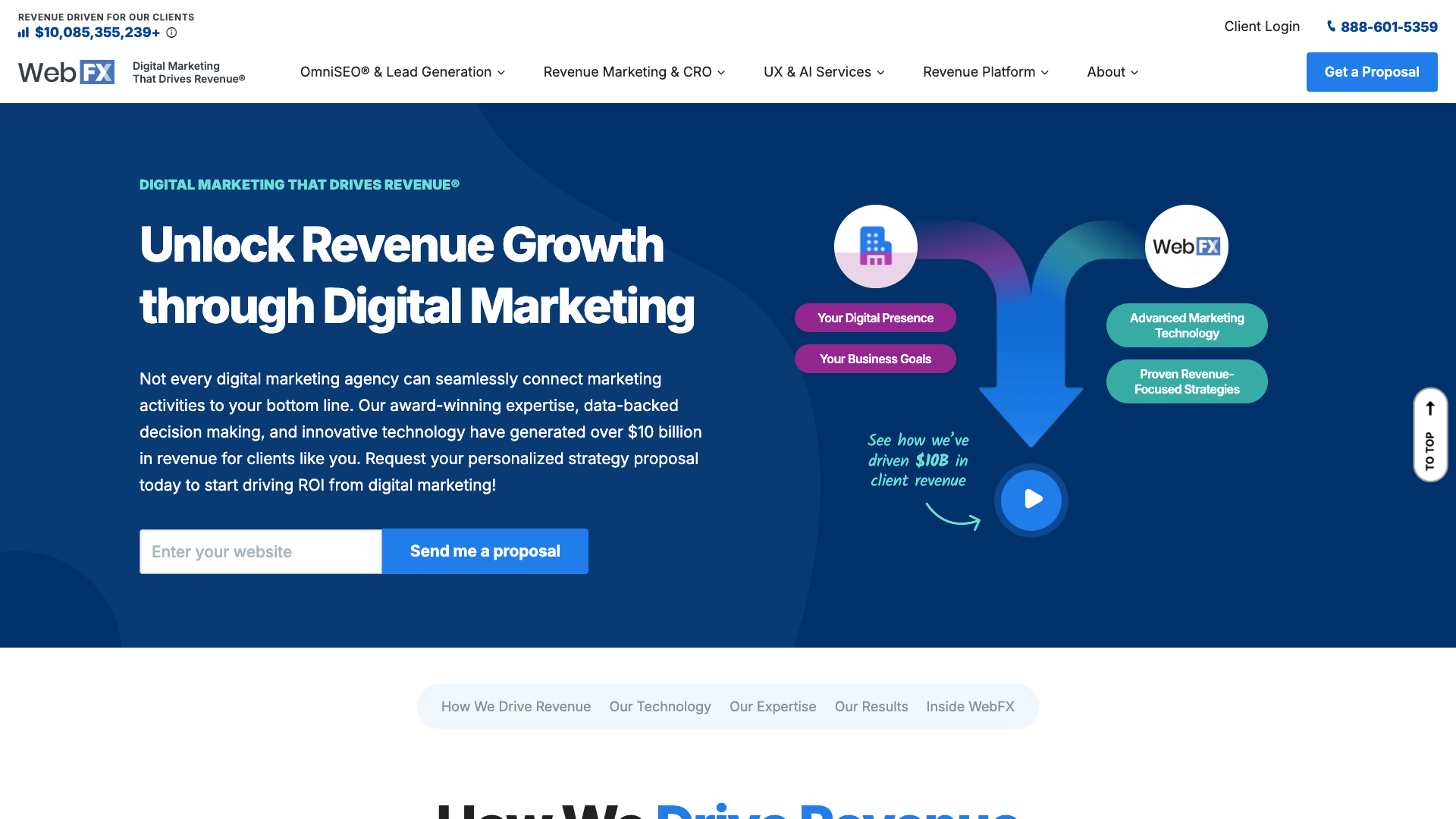
Specialization: Full-Service Digital Marketing with Revenue Focus
Company Overview: WebFX positions itself as “The Digital Marketing Agency That Drives Revenue” with over 25 years of industry experience. With a team of 500+ digital marketing experts, they’ve built a reputation for delivering measurable business outcomes rather than just marketing metrics.
Key Achievements:
- Generated over $10 billion in revenue for clients
- 1,100+ verified client reviews across G2, Clutch, Capterra platforms
- Wikipedia and Wikidata entries indicating industry recognition
- 25+ years of continuous operation and evolution
Services Offered:
- Search Engine Optimization (SEO): Technical SEO, local SEO, enterprise SEO, e-commerce SEO
- Pay-Per-Click Advertising (PPC): Google Ads, Bing Ads, social media advertising, display advertising
- Content Marketing: Strategy, creation, distribution, and optimization
- Web Design & Development: Custom websites, e-commerce platforms, conversion optimization
- Social Media Marketing: Strategy, content creation, community management, paid social
- Marketing Automation: Email marketing, lead nurturing, marketing technology integration
What Makes WebFX Stand Out:
Comprehensive Full-Service Approach: Unlike specialist agencies focusing on one or two channels, WebFX integrates all digital marketing disciplines into cohesive strategies. This eliminates the coordination challenges of working with multiple vendors and ensures consistent messaging across touchpoints.
Revenue-Driven Metrics: While many agencies focus on impressions, clicks, or rankings, WebFX emphasizes revenue generation and business growth. Their $10 billion in client revenue generated demonstrates ability to move beyond vanity metrics to business outcomes.
Extensive Social Proof: With over 1,100 verified reviews and presence on multiple review platforms, WebFX provides transparency into client experiences. This level of validation is rare in the agency world.
Longevity & Stability: 25+ years in business signals ability to evolve with marketing changes, financial stability, and operational maturity. They’ve survived multiple marketing paradigm shifts from desktop to mobile, traditional to digital, and are now navigating the AI transformation.
Best For:
- Small to mid-sized businesses seeking comprehensive digital marketing without managing multiple vendors
- Companies prioritizing measurable revenue outcomes over activity metrics
- Organizations wanting a proven partner with long track record
- Businesses needing integrated services across SEO, PPC, content, web design, and social
SmartSites
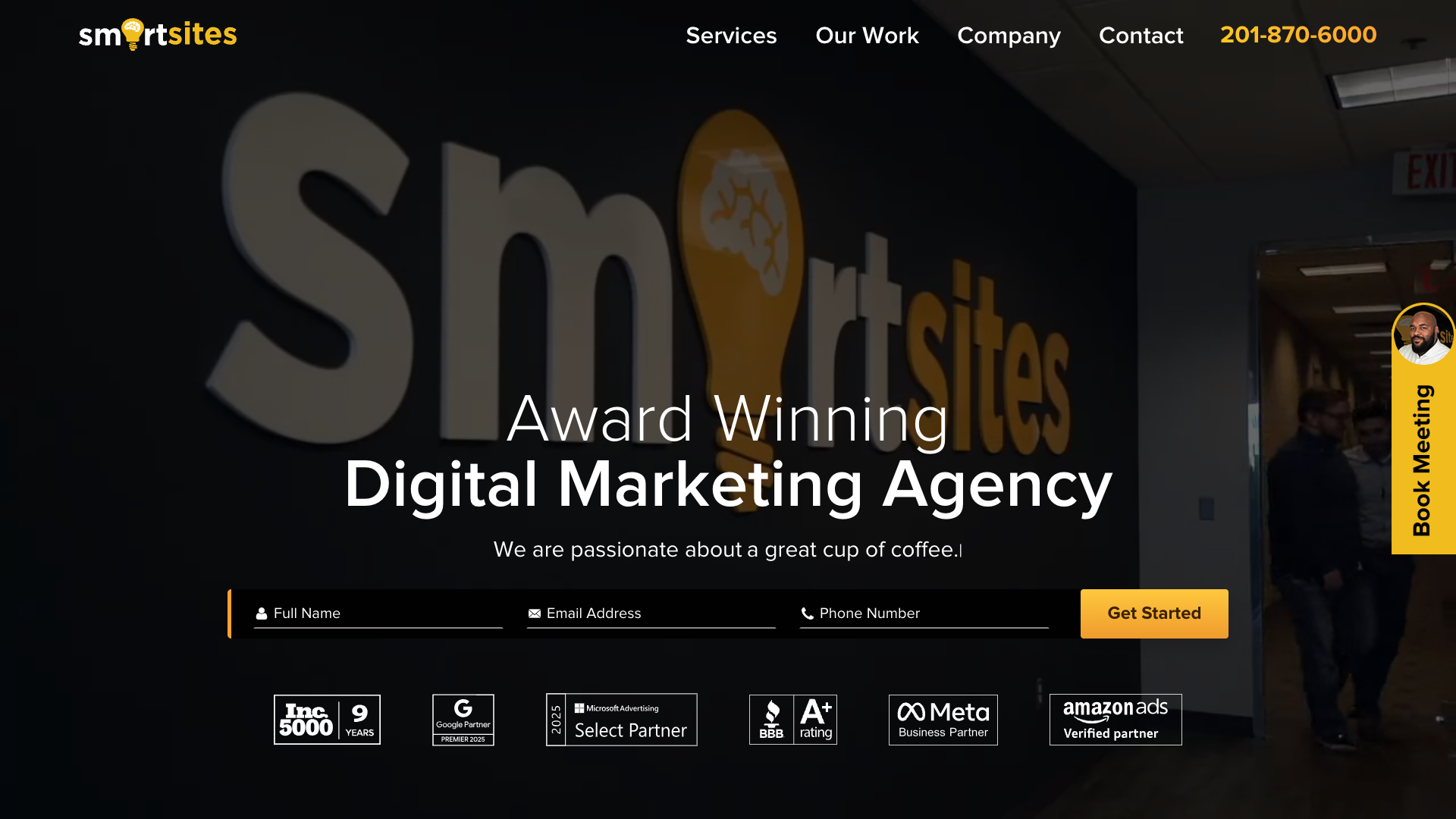
Specialization: Award-Winning Digital Marketing with Premier Partnerships
Company Overview: SmartSites is an award-winning digital marketing agency headquartered in Paramus, New Jersey, serving businesses nationwide. What distinguishes SmartSites is their collection of premier partner certifications from major advertising platforms, signaling platform expertise and preferential access to resources.
Awards & Partner Status:
- Google Premier Partner (top tier of Google partner program)
- Microsoft Advertising Select Partner (2025)
- Meta Business Partner (Facebook/Instagram advertising)
- Amazon Ads Verified Partner
- Inc. 5000 recognition for fast-growing companies
- BBB A+ Rating for business ethics and customer satisfaction
Achievements:
- 900+ websites launched successfully
- $100+ million in client revenue generated
- Described as “#1 best rated digital marketing agency”
- Strong client testimonials highlighting rapid results
Services Offered:
- Web Design & Development: Custom websites, e-commerce platforms, WordPress, Shopify
- Search Engine Optimization (SEO): Local SEO, national SEO, e-commerce SEO
- Pay-Per-Click Advertising (PPC): Google Ads, Microsoft Ads, Facebook Ads, Instagram Ads, Amazon Ads
- Email & SMS Marketing: Automation, segmentation, campaign management
- Social Media Marketing: Organic and paid social across all major platforms
What Makes SmartSites Stand Out:
Premier Partner Certifications: SmartSites holds top-tier partner status with Google, Microsoft, Meta, and Amazon—a rare combination. These certifications require meeting strict performance standards and provide access to beta features, dedicated support, and platform insights unavailable to standard advertisers.
Multi-Platform Advertising Expertise: With verified partnerships across the four dominant advertising platforms (Google, Microsoft, Meta, Amazon), SmartSites can orchestrate sophisticated cross-platform campaigns with deep platform-specific optimization.
Results-Driven Culture: Client testimonials consistently highlight rapid results and revenue generation, not just activities. The $100+ million in client revenue and 900+ successful website launches demonstrate execution capability at scale.
Awards & Recognition: Inc. 5000 recognition signals sustained revenue growth—companies must demonstrate significant year-over-year growth to make this prestigious list. Combined with BBB A+ rating, this indicates both business performance and ethical operations.
Accessible Yet Professional: While holding elite certifications, SmartSites serves both small businesses and large enterprises, providing enterprise-grade capabilities without enterprise-only pricing.
Best For:
- Businesses prioritizing Google, Microsoft, Meta, or Amazon advertising
- E-commerce companies needing platform-specific expertise
- Organizations wanting proven results and strong client testimonials
- Companies seeking premier partner benefits and platform access
- Small to mid-sized businesses wanting enterprise capabilities
Disruptive Advertising
Specialization: Performance Marketing with Measurable Growth Guarantee
Company Overview: Disruptive Advertising, founded in 2012 and headquartered in Pleasant Grove, Utah, positions itself as a performance marketing agency for authentic brands and marketers. With a team of 120+ employees and revenue between $10-50 million, they’ve built a reputation for results-driven marketing with accountability.
Notable Achievements:
- Over 10,000+ marketing audits completed
- $1 billion+ managed in ad spend
- 1,000+ positive client reviews
- 50+ local and national awards
- Manages hundreds of millions in digital advertising annually
Unique Value Proposition:
- 90-Day Performance Guarantee: Measurable growth within 90 days or money back
- No Long-Term Contracts: Month-to-month flexibility demonstrating confidence in results
- Complete Funnel Optimization: From click to close, not just ad management
Services Offered:
- Pay-Per-Click Marketing: Google Ads, Facebook, Instagram, LinkedIn, TikTok, YouTube advertising
- Search Engine Optimization (SEO): Technical SEO, content optimization, link building
- Display Advertising: Programmatic display, retargeting, banner ad campaigns
- Landing Page Optimization: Conversion-focused design and testing
- Analytics & Reporting: Custom dashboards, attribution, performance analysis
What Makes Disruptive Advertising Stand Out:
Performance Guarantee & No Contracts: The 90-day growth guarantee backed by money-back promise is rare in agency world. Combined with no long-term contracts, this signals extraordinary confidence in their ability to deliver results. Most agencies require 6-12 month commitments—Disruptive’s month-to-month model puts pressure on them to perform continuously.
$1 Billion+ in Managed Ad Spend: Managing over $1 billion in advertising spend across hundreds of clients demonstrates sophisticated campaign management capabilities, platform expertise, and budget optimization skills. This level of spend provides data-driven insights unavailable to smaller agencies.
Complete Funnel Approach: Rather than just driving traffic, Disruptive optimizes the entire customer journey from initial click through conversion and retention. This holistic approach ensures marketing dollars aren’t wasted on traffic that doesn’t convert.
Collaborative Partnership Model: Reviews consistently highlight Disruptive’s collaborative approach—working alongside client teams rather than operating in silos. This integration ensures alignment between marketing tactics and business goals.
Multi-Platform Expertise: While many agencies specialize in one or two platforms, Disruptive maintains expertise across Google, Facebook, Instagram, LinkedIn, TikTok, and YouTube—enabling cohesive cross-platform strategies that meet customers wherever they are.
Waste Elimination Focus: Core philosophy is eliminating wasted marketing spend through data analysis, targeting refinement, and continuous optimization. For companies concerned about budget efficiency, this approach provides accountability.
Best For:
- Businesses wanting performance guarantees and accountability
- Companies preferring flexibility over long-term commitments
- Organizations with significant ad spend seeking optimization ($50K+ monthly)
- Brands needing multi-platform paid advertising expertise
- Businesses prioritizing conversion optimization, not just traffic
- Companies wanting collaborative partnership vs. hands-off vendor
Common Mistakes to Avoid When Choosing a Marketing Agency
Learning from others’ mistakes is cheaper than making your own. Here are the most common—and costly—errors businesses make:
1. Failing to Set Clear Goals and Expectations
The Mistake: Starting agency search without specific, measurable objectives. “We need more leads” or “improve our online presence” are too vague.
Why It’s Costly: Agencies can’t align strategies to goals they don’t understand. You’ll get generic tactics rather than customized approaches.
How to Avoid: Define specific goals before contacting agencies: “Generate 500 qualified leads per month at $50 CAC” or “Increase e-commerce revenue by 40% in 12 months.” Share expected timelines, budget ranges, and success metrics.
2. Not Understanding Your Own Needs
The Mistake: Hiring an agency excellent at services you don’t actually need. Following trends (TikTok! Influencers! AI!) without strategic rationale.
Why It’s Costly: You pay for expertise in channels that don’t drive your business results. A B2B enterprise software company may not need TikTok—they need LinkedIn thought leadership and account-based marketing.
How to Avoid: Audit current marketing efforts. Which channels drive customers? Where do prospects research? What’s your customer journey? Match agency strengths to your strategic needs, not industry hype.
3. Choosing Based on Price Alone
The Mistake: Selecting the lowest bidder to save money.
Why It’s Costly: Cheap agencies are often inexperienced, overwhelmed with clients to compensate for low prices, or lack sophisticated capabilities. Poor results cost more than premium pricing. A $3,000/month agency that generates $50,000 in revenue is cheaper than a $1,500/month agency that generates $5,000.
How to Avoid: Evaluate value, not just cost. Calculate expected ROI: if an agency costs $5,000/month but generates $50,000 in incremental revenue at 30% margin, they’ve delivered $15,000 in gross profit against $5,000 cost. Focus on return, not expense.
4. Accepting Cookie-Cutter Approaches
The Mistake: Agencies presenting generic strategies without customization.
Why It’s Costly: Every business has unique audiences, competitive dynamics, and buyer journeys. One-size-fits-all rarely produces exceptional results. According to Content Marketing Institute research, 65% of effective content marketing teams point to content relevance and quality as key—impossible to achieve with generic templates.
How to Avoid: During pitches, ask “How would you customize this approach for our specific business?” If they can’t articulate clear customization, they’re selling templates.
5. Skipping Due Diligence
The Mistake: Not checking references, verifying results, or reviewing case studies thoroughly.
Why It’s Costly: You discover issues after signing contracts—poor communication, missed deadlines, inability to execute, overpromised results.
How to Avoid:
- Request 2-3 references for similar businesses or industries
- Actually call references and ask tough questions
- Review case studies for results, not just activities
- Google the agency for reviews and complaints
- Check their own digital presence (website, blog, social)—if they can’t market themselves effectively, can they market you?
6. Ignoring Industry Experience
The Mistake: Partnering with agencies unfamiliar with your industry.
Why It’s Costly: Each industry has unique challenges, buyer behaviors, regulations, and competitive dynamics. Healthcare marketing faces HIPAA compliance; financial services has strict advertising regulations; B2B SaaS has long sales cycles. Generic marketing knowledge is insufficient.
How to Avoid: Prioritize agencies with proven track records in your industry. Ask: “What’s your experience in [industry]?” “Can you share case studies from similar companies?” “What industry-specific challenges should we expect?“
7. Overlooking Cultural Fit
The Mistake: Focusing solely on capabilities while ignoring whether values, work styles, or communication approaches align.
Why It’s Costly: Misaligned cultures create friction, miscommunication, missed deadlines, and frustration. Daily collaboration with mismatched partners drains energy and productivity.
How to Avoid: During discovery calls, assess:
- Communication style: Do they explain clearly? Listen well? Ask good questions?
- Decision-making: Collaborative or directive?
- Pace: Move fast and iterate or plan thoroughly then execute?
- Values: What do they care about beyond profits?
Trust your gut—if something feels off during courtship, it won’t improve after signing.
8. Expecting Unrealistic Results
The Mistake: Believing promises of instant results, guaranteed #1 rankings, or viral success.
Why It’s Costly: True SEO requires 3-6 months minimum. Brand building takes time. Sustainable growth compounds gradually. Chasing unrealistic promises leads to disappointment and wasted budget.
How to Avoid: Be skeptical of guarantees. No ethical agency can guarantee specific rankings (Google’s algorithm is proprietary and constantly changing). Ask for realistic timelines based on similar client experiences.
9. Not Reviewing Contracts Carefully
The Mistake: Signing without understanding commitment length, exit terms, ownership of assets, or performance clauses.
Why It’s Costly: You discover you’re locked into 12-month contracts with steep exit fees. Or the agency owns all creative assets, content, and even your website. Or you can’t access campaign data after ending relationship.
How to Avoid:
- Read contracts thoroughly; get legal review for large commitments
- Clarify ownership: Who owns website, content, creative assets, customer data?
- Understand exit terms: How much notice? Exit fees? Data transfer?
- Check auto-renewal clauses
- Ensure access to all campaign platforms and data
10. Lack of Transparency Concerns
The Mistake: Accepting agencies that guard their methods, dodge performance questions, or refuse data access.
Why It’s Costly: Transparency issues signal deeper problems. If they won’t explain approaches or share data, they may be hiding poor results, using black-hat tactics, or providing minimal value.
How to Avoid:
- Insist on direct access to Google Ads, Facebook Ads, Analytics, and other platforms
- Ask: “Will we have login credentials and admin access to all platforms?”
- Request detailed reporting on methodology, not just results
- If they’re evasive about tactics or data, walk away
Critical Questions to Ask Potential Marketing Agencies
Thorough vetting requires asking tough questions and evaluating answers critically. Here’s your comprehensive question framework:
Agency Capabilities & Experience
1. What industries do you specialize in, and can you share relevant case studies? Look for: Specific experience in your industry with documented results
2. What is your agency’s size, structure, and team expertise? Look for: Team depth, roles, specializations, and qualifications
3. How long has your agency been in business? Look for: Longevity signals stability; newer agencies may offer innovation
4. What certifications, partnerships, or awards has your agency earned? Look for: Google Premier Partner, Microsoft Select Partner, Meta Business Partner, industry awards
5. Can you provide client references we can contact? Look for: Willingness to provide 2-3 references; hesitation is a red flag
Strategy & Approach
6. What is your approach to developing marketing strategies? Look for: Customization, research phase, strategic frameworks, business alignment
7. How do you customize strategies for different clients versus using templates? Look for: Specific examples of customization; warning sign if all clients get same approach
8. How do you stay current with marketing trends and platform changes? Look for: Continuous learning, testing, platform beta access, thought leadership
9. What is your process for understanding our business, audience, and goals? Look for: Discovery phase, stakeholder interviews, customer research, competitive analysis
10. How do you integrate with our existing marketing efforts and internal team? Look for: Collaboration approach, communication protocols, tools for coordination
Team & Account Management
11. Who will be our main point of contact, and what is their background? Look for: Senior person, relevant experience, direct access
12. What is the average tenure of your account staff? Look for: Low turnover signals healthy culture; high turnover creates continuity issues
13. How will account staff interact with our team (frequency, format)? Look for: Regular meetings, clear communication channels, defined cadence
14. What is your team’s educational background and ongoing training? Look for: Relevant degrees, certifications, continuous learning investment
15. How do you handle team turnover or personnel changes? Look for: Knowledge documentation, transition protocols, backup team members
Services & Execution
16. What specific services do you offer (SEO, PPC, content, social, etc.)? Look for: Breadth matching your needs; depth in priority channels
17. What marketing technology platforms and tools do you use? Look for: Modern tech stack, expertise in tools relevant to your business
18. Do you develop tools internally or rely on third-party platforms? Look for: Proprietary tools signal innovation; all third-party may limit capabilities
19. How do you handle content creation (in-house vs. outsourced)? Look for: Quality control processes, writer expertise, approval workflows
20. What is your process for campaign development and launch timelines? Look for: Realistic timelines, clear milestones, collaborative approach
Measurement & Reporting
21. What tracking and reporting tools do you use? Look for: Google Analytics 4, data visualization tools, attribution platforms
22. How do you measure campaign success and ROI? Look for: Business metrics (revenue, CAC, LTV) not just marketing metrics (clicks, impressions)
23. What KPIs do you recommend tracking for our business? Look for: Customized metrics aligned with goals; red flag if same KPIs for everyone
24. How often will we receive performance reports? Look for: Monthly minimum; weekly or bi-weekly for active campaigns
25. Do we have direct access to campaign data and analytics platforms? Look for: Yes with admin rights; no access is a major red flag
Budget & Pricing
26. What is your pricing model (retainer, percentage of spend, performance-based)? Look for: Transparency, alignment with industry norms, clear value proposition
27. What results can we expect for our budget level? Look for: Realistic expectations based on similar clients; skepticism of guarantees
28. How do you handle budget allocation across channels? Look for: Data-driven approach, testing methodology, optimization based on performance
29. What is included in your fees versus additional costs? Look for: Detailed breakdown; watch for hidden fees or surprise charges
30. How do you track and report budget completion rates? Look for: Transparent spend reporting, recommendations for optimization
Compliance & Security
31. What are your data security and privacy practices? Look for: Encryption, access controls, security certifications
32. How do you ensure compliance with regulations (GDPR, CCPA, etc.)? Look for: Documented processes, legal review, consent management
33. What is your process for handling sensitive client information? Look for: NDAs, data handling policies, confidentiality agreements
Contract & Commitment
34. What is the contract length and commitment required? Look for: Flexible terms; be wary of long lock-ins without performance clauses
35. What are the terms for terminating the agreement? Look for: Reasonable notice period (30-90 days); watch for steep exit fees
36. Who owns the creative assets, content, and data? Look for: You own everything created; walk away if agency claims ownership
37. What happens to our campaigns and assets if we part ways? Look for: Complete transfer of assets, data export, platform access maintained
How to Evaluate Marketing Agency Proposals
After receiving proposals from shortlisted agencies, use this structured framework to compare them objectively:
Proposal Evaluation Scorecard
Rate each criterion on a 1-10 scale. Weight criteria based on your priorities (some may be more important than others for your specific situation).
1. Understanding of Your Business (Weight: ____)
Score 1-10:
- Does proposal demonstrate deep understanding of your industry?
- Have they identified your specific challenges and opportunities accurately?
- Do they understand your target audience and buyer journey?
- Is the approach customized versus generic?
2. Strategic Approach (Weight: ____)
Score 1-10:
- Is strategy aligned with your business goals?
- Does it address full-funnel marketing versus single-channel focus?
- Are recommendations data-driven and evidence-based?
- Does strategy balance quick wins with long-term sustainable growth?
3. Capabilities & Expertise (Weight: ____)
Score 1-10:
- Does agency have proven expertise in required channels?
- Do case studies demonstrate relevant experience?
- Is team qualified with appropriate certifications and training?
- Do they have necessary technology, tools, and platform access?
4. Proposed Team & Resources (Weight: ____)
Score 1-10:
- Are team members experienced and qualified?
- Is staffing level appropriate for your needs?
- Are roles and responsibilities clearly defined?
- What is account team’s tenure and stability?
5. Measurement & Reporting (Weight: ____)
Score 1-10:
- Are proposed KPIs aligned with business outcomes?
- Is reporting frequency and format adequate?
- Do you get direct access to data, dashboards, and platforms?
- Are attribution and tracking methods sophisticated?
6. Timeline & Deliverables (Weight: ____)
Score 1-10:
- Are timelines realistic and achievable?
- Are deliverables clearly defined and measurable?
- Are milestones and checkpoints appropriate?
- Is ramp-up period reasonable for your urgency?
7. Budget & Value (Weight: ____)
Score 1-10:
- Is pricing transparent and justified?
- Does budget allocation match priorities?
- Is ROI projection realistic and supported by data?
- Are there hidden costs, surprise fees, or unclear charges?
8. Cultural Fit (Weight: ____)
Score 1-10:
- Does agency’s communication style match yours?
- Do values and work approaches align?
- Is collaboration approach compatible with your culture?
- Does chemistry feel right based on interactions?
Scoring Methodology
Calculate Total Score: (Score 1 × Weight 1) + (Score 2 × Weight 2) + … (Score 8 × Weight 8) = Total
Compare Agencies:
- Create apples-to-apples comparison across all proposals
- Highest total score + gut feel = best choice
- Don’t ignore qualitative factors (cultural fit, trust, enthusiasm)
Decision Framework:
- If scores are close (within 10%), cultural fit becomes tiebreaker
- If one agency scores 20+ points higher, data suggests clear winner
- If uncertainty remains, request second meetings to address concerns
Marketing Trends for 2026: What Your Agency Must Navigate
Understanding the forces shaping marketing helps evaluate whether agencies are forward-thinking or relying on outdated playbooks.
1. AI as the Strategic Operating System
What’s Happening: AI is evolving from creative tool to strategic operating system automating analytics, optimization, media buying, and customer journey orchestration. Meta aims to fully automate advertising with AI by end of 2026. According to Search Engine Journal, 92% of companies plan to increase AI investments.
Why It Matters: Agencies unable to leverage AI will fall behind in efficiency, targeting precision, and creative production speed. However, Smart Insights research notes that 95% of generative AI pilots fail to deliver measurable business value due to misalignment and poor data infrastructure.
What to Ask Agencies: “How do you use AI in campaign management, creative production, and optimization?” “What’s your approach to ensuring AI adds value versus creating noise?“
2. Conversational Search & Answer Engine Optimization (AEO)
What’s Happening: Search is evolving from keyword queries to conversational interactions. Google AI Overviews and Bing Copilot are changing visibility metrics. Research shows a 24% drop in organic clicks when AI Overviews appear.
Why It Matters: Traditional SEO focused on rankings. New reality requires optimizing for featured snippets, voice queries, and AI-generated responses. Brands must provide authoritative, answer-focused content that AI can cite.
What to Ask Agencies: “How do you approach Answer Engine Optimization?” “How has AI-powered search changed your SEO strategies?“
3. Video-Commerce Boom
What’s Happening: Short-form, live, and interactive video driving purchases directly. AI-created video ads expected to represent 40% of all video ads by 2026. Research shows 89% of consumers want more brand videos, with 83% preferring video over text for educational content.
Why It Matters: Video production at scale used to require significant budgets. AI democratizes video creation, but quality and strategy still matter. Shoppable video with product overlays and purchase triggers is becoming standard.
What to Ask Agencies: “What’s your video production capability?” “How do you create video at scale?” “Can you execute shoppable video campaigns?“
4. Privacy-First Data Revolution
What’s Happening: Third-party cookies disappearing, forcing fundamental shift to first-party data strategies. Brands must build “data spines” with customer data platforms, conversion APIs, and value-added experiences for consent.
Why It Matters: Advertising targeting and measurement based on third-party cookies is ending. First-party data becomes competitive advantage. Agencies must understand modern data infrastructure and privacy-compliant tactics.
What to Ask Agencies: “How do you approach first-party data collection and activation?” “What’s your strategy for cookie-less targeting and measurement?“
5. Retail Media Networks Go Mainstream
What’s Happening: Retail media networks (RMNs) like Amazon, Walmart, Target advertising platforms projected to reach $62 billion in 2025, expected to exceed 20% of digital spend by 2026.
Why It Matters: RMNs offer closed-loop measurement tying ads directly to product-level outcomes. For brands selling through retail channels, RMNs provide powerful targeting and attribution.
What to Ask Agencies: “What’s your experience with retail media networks?” “Can you manage Amazon Advertising, Walmart Connect, etc.?“
6. Creator Economy Evolves to Co-Creation
What’s Happening: Shift from transactional paid posts to genuine partnerships where creators help develop products and campaigns. Micro-influencer authenticity outperforms celebrity endorsements.
Why It Matters: Authentic creator partnerships drive stronger performance than traditional sponsorships. Agencies must have creator networks and relationship management capabilities.
What to Ask Agencies: “What’s your approach to influencer marketing?” “Do you focus on celebrity influencers or micro-influencers?” “Can you share creator partnership case studies?“
7. Community + Authenticity = New Brand Moat
What’s Happening: Audiences seek belonging and authentic engagement. Brands investing in owned channels (forums, apps, Discord/Slack communities) and employee advocacy programs.
Why It Matters: Community-driven growth creates sustainable competitive advantages through engagement and retention, not just acquisition. Community metrics (engagement, retention) matter alongside traditional marketing KPIs.
What to Ask Agencies: “How do you approach community building?” “What’s your experience with owned community platforms?“
8. Marketing Mix Modeling (MMM) Replaces Attribution
What’s Happening: Traditional multi-touch attribution collapsing under privacy constraints. MMM regaining prominence for measurement, integrating online, offline, and walled-garden data.
Why It Matters: Last-click attribution and platform-reported conversions are increasingly unreliable. MMM provides more accurate view of marketing effectiveness by using statistical analysis.
What to Ask Agencies: “How do you approach marketing measurement?” “Do you use Marketing Mix Modeling?” “How do you attribute results across platforms?“
9. Immersive Experiences & Gamification
What’s Happening: AR, VR, and gamified campaigns creating memorable brand experiences. Platforms shifting from passive consumption to interactive engagement. AR try-ons, virtual experiences, and live quizzes with utility.
Why It Matters: Immersive experiences drive higher engagement and memorability than static content. As metaverse and AR technologies mature, early adopters gain advantages.
What to Ask Agencies: “What’s your experience with AR/VR marketing?” “Can you create gamified campaigns?“
10. Human Skills for AI Era
What’s Happening: While AI automates tasks, human skills in data literacy, AI fluency, and cross-channel orchestration become differentiators. Research shows only 1% of companies consider themselves fully AI-mature.
Why It Matters: The winning combination is AI tools + human strategy. Agencies investing in team training across data analytics, AI governance, and strategic thinking outperform those just buying AI tools.
What to Ask Agencies: “How are you training your team on AI and emerging technologies?” “What distinguishes your human expertise from AI automation?”
Understanding Different Types of Marketing Agencies
Not all agencies are structured the same. Understanding different models helps match the right type to your needs.
By Service Scope
Full-Service Agencies (like WebFX, SmartSites)
- Offer comprehensive marketing services across all channels
- SEO, PPC, social media, content, web design, email, automation
- Best for: Businesses wanting single partner for all marketing needs
- Pros: Integrated strategy, single point of contact, cohesive campaigns
- Cons: Higher cost, may not be specialist in all areas
Specialist/Niche Agencies
- Focus on specific channel or service (SEO-only, PPC-only, social-only)
- Deep expertise in one or two areas
- Best for: Businesses with specific channel needs or existing in-house team
- Pros: Deep expertise, cutting-edge tactics, often lower cost
- Cons: Need multiple agencies for full strategy, integration challenges
Performance Marketing Agencies (like Disruptive Advertising)
- Focus on measurable results and ROI
- Specialize in direct response and conversion optimization
- Best for: Businesses prioritizing measurable growth and revenue
- Pros: Results-driven, data focus, accountability
- Cons: May prioritize short-term gains over brand building
By Target Market
Enterprise Agencies
- Serve large corporations with complex needs
- High budgets ($100K+ monthly), multiple stakeholders
- Best for: Large companies with $1M+ annual marketing budgets
- Pros: Experience with complexity, sophisticated capabilities
- Cons: Very expensive, may not be nimble
Small Business Agencies
- Tailored services for SMBs with limited budgets
- Best for: Small to mid-sized businesses ($5K-$25K monthly budgets)
- Pros: Affordable, understanding of SMB challenges, flexible
- Cons: Limited resources, may lack enterprise capabilities
By Industry Specialization
Vertical-Specific Agencies
- Specialize in specific industries (healthcare, B2B SaaS, ecommerce, legal)
- Deep understanding of industry regulations, buyer behavior, channels
- Best for: Businesses in specialized or regulated industries
- Pros: Industry expertise, proven playbooks, compliance knowledge
- Cons: Limited flexibility if you want to diversify or pivot
Generalist Agencies
- Work across multiple industries
- Best for: Businesses in mainstream industries
- Pros: Diverse perspectives, cross-industry insights
- Cons: May lack deep industry knowledge
In-House vs. Agency vs. Hybrid
In-House Marketing Team
- Employees dedicated to your marketing
- Pros: Brand knowledge, alignment, availability, long-term investment
- Cons: Limited expertise breadth, resource constraints, hiring challenges
Agency Partnership
- External partner handling marketing
- Pros: Specialized expertise, scalability, no hiring/training overhead
- Cons: Less brand intimacy, potential misalignment, ongoing fees
Hybrid Model
- In-house team + agency partnership
- In-house handles strategy and day-to-day; agency provides specialized expertise
- Best for: Mid to large companies wanting control + expertise
- Pros: Best of both worlds, flexibility, cost efficiency
- Cons: Coordination complexity, potential misalignment
ROI Metrics and Measurement: What Success Looks Like
According to Gartner research, 83% of marketers cite proving ROI as their top challenge. Yet data-driven organizations are 6% more profitable than competitors. Here’s how to measure what matters:
The Essential Distinction
ROI tells the whole story—business outcomes that impact the bottom line.
KPIs reveal the chapters—leading indicators of future ROI outcomes.
Agencies should track both, but report in business terms executives understand.
Essential Digital Marketing Metrics
Acquisition Metrics:
Customer Acquisition Cost (CAC): Total marketing spend divided by new customers acquired. Lower CAC means more efficient marketing.
Cost Per Lead (CPL): Marketing spend divided by leads generated. Tracks top-of-funnel efficiency.
Cost Per Acquisition (CPA): Cost to acquire a paying customer through specific channel or campaign.
Marketing Qualified Leads (MQLs): Leads meeting criteria for sales readiness based on behavior and demographics.
Performance Metrics:
Conversion Rate: Percentage of visitors taking desired action (form submission, purchase, signup). Optimization focus drives significant revenue impact.
Click-Through Rate (CTR): Clicks divided by impressions. Indicates ad relevance and creative effectiveness.
Return on Ad Spend (ROAS): Revenue generated per dollar spent on ads. 3:1 or higher is generally healthy.
Traffic to Lead Ratio: Percentage of website visitors converting to leads. Indicates website effectiveness.
Value Metrics:
Customer Lifetime Value (CLV/LTV): Total revenue from customer over entire relationship. Critical for understanding true customer worth.
Average Order Value (AOV): Average transaction size. Upselling and bundling increase AOV.
LTV:CAC Ratio: Should be 3:1 or higher for healthy business. If it costs $100 to acquire customer worth $300, economics work.
Channel-Specific Metrics:
Organic Search Traffic: Visitors from unpaid search results. SEO effectiveness indicator.
Email Open Rate & Click Rate: Email engagement metrics. Industry benchmarks vary; B2B averages 21% open, 3% click.
Social Engagement Rate: Likes, comments, shares per follower. Indicates content resonance.
Landing Page Conversion Rate: Conversion rate of specific pages designed for campaigns.
Modern Attribution Approaches for 2026
The Challenge: Traditional multi-touch attribution is collapsing under privacy constraints. Platform-reported conversions are increasingly unreliable.
The Solution: Marketing Mix Modeling and incrementality testing.
Marketing Mix Modeling (MMM):
- Statistical analysis of marketing impact across channels
- Integrates online, offline, and walled-garden data
- Provides true lift and optimal budget allocation
- Reports in business terms: incremental revenue, ROI
Incrementality Testing:
- Measures true lift from campaigns using control groups
- Tests whether marketing drives outcomes or just captures existing demand
- More accurate than platform attribution
Best Practices for 2026:
- Focus on metrics showing cause and effect, not just activity
- Align KPIs with business outcomes (revenue, profit, retention)
- Measure beyond clicks: brand lift, assisted conversions, FAQ visibility
- Integrate online and offline data for complete picture
- Use control groups and incrementality testing
- Report in terms executives understand (revenue impact, not impressions)
Martech Utilization Reality
According to Gartner:
- Only 49% of martech tools are actively used (down from 58% in 2020)
- Only 15% of organizations are high performers with positive martech ROI
- Martech accounts for 25.4% of marketing budgets
The Lesson: More tools ≠ better results. Focus on rightsizing tech around measurable use cases. Your agency should maximize existing tool value before adding new platforms.
Making Your Final Decision
After proposals, references, and evaluation, use this decision framework:
Final Decision Criteria
Must-Haves (Non-Negotiable):
- Demonstrated expertise in your priority channels
- Transparent reporting with data access
- Cultural alignment and communication compatibility
- References checking out positively
- Fair contract terms (no ownership claims, reasonable exit)
Nice-to-Haves (Differentiators):
- Industry-specific experience
- Innovative approaches and thought leadership
- Certifications and platform partnerships
- Advanced capabilities (AI, MMM, attribution)
- Team stability and low turnover
Red Flags That Should Disqualify Agencies
Immediate Disqualifiers:
- Guaranteed rankings or viral success promises
- Refusal to provide references
- Won’t grant platform access or data ownership
- Black-hat or questionable tactics
- Pressure tactics or hard sells
- Evasive about methods or results
- Claims to own your creative assets or website
- Bad references or concerning online reviews
The Final Choice
If scores are close: Let cultural fit be the tiebreaker. You’ll work closely with this team—chemistry matters.
If one agency scores significantly higher: Data suggests the clear winner. Trust the framework.
If uncertainty remains: Request second meetings, ask more questions, or expand your search.
Trust your gut: If something feels wrong during courtship, it won’t improve after signing. Conversely, if everything aligns and you’re excited, that enthusiasm signals good partnership potential.
Conclusion: Choosing Your Marketing Partner for 2026 Success
The marketing agency you choose will profoundly impact your business growth, competitive positioning, and marketing efficiency. In 2026’s complex landscape—with AI automating creative, privacy regulations ending third-party cookies, new platforms emerging constantly, and measurement evolving—the right partner provides strategic advantage.
Key considerations for your decision:
✅ Strategic alignment over capabilities alone - The agency must understand your business model, customers, and goals, not just marketing tactics
✅ 2026-ready capabilities - AI proficiency, Answer Engine Optimization, first-party data strategies, Marketing Mix Modeling, and video at scale are table stakes
✅ Full-funnel integration - Siloed channel expertise is insufficient; cohesive customer journeys spanning awareness through retention drive results
✅ Measurement rigor - Focus on business outcomes (CAC, LTV, ROAS, revenue) not vanity metrics (impressions, clicks)
✅ Cultural compatibility - Values alignment, communication style fit, and collaboration approach determine partnership success
✅ Transparency and accountability - Direct platform access, clear reporting, and performance-based thinking create trust
✅ Fair contract terms - You own all assets; reasonable exit terms; no hidden fees
Whether you choose a full-service agency like WebFX for comprehensive capabilities, an award-winning partner like SmartSites for premier platform certifications, or a performance-focused agency like Disruptive Advertising for guaranteed results—the critical factors are strategic fit, execution capability, and measurement discipline.
Marketing complexity will only increase. The agency you choose should not just handle today’s tactics but position you for tomorrow’s opportunities. Take time with evaluation. Ask tough questions. Check references thoroughly. Use the frameworks in this guide to compare objectively.
The right marketing partner becomes an extension of your team, a strategic advisor, and a growth accelerator. The wrong partner wastes budget, creates frustration, and puts you at competitive disadvantage. Choose wisely.
Next Steps
Ready to find your ideal marketing agency partner? Here’s your action plan:
- Define your goals and requirements using the evaluation criteria in this guide (2-3 hours)
- Shortlist 3-5 agencies based on specialization, industry experience, and budget alignment (1-2 days)
- Request detailed proposals with strategy, team, timeline, and pricing (1 week)
- Ask the 37 critical questions during discovery calls to assess capabilities and fit (1-2 weeks)
- Check references thoroughly from similar businesses in your industry (3-5 days)
- Use the scorecard framework to evaluate proposals objectively (1-2 days)
Contact ClearPick for personalized marketing agency recommendations based on your specific needs - completely free for you.
Last updated: December 31, 2025 | Read time: 12 minutes