The custom software development market is experiencing explosive growth—reaching $53 billion in 2025 and expanding at over 22% annually. As off-the-shelf solutions struggle to meet unique business requirements, more companies are turning to custom development partners.
But with hundreds of firms claiming expertise, how do you find the right one?
This comprehensive guide profiles today’s leading custom software development companies, explains evaluation criteria, pricing models, and provides a decision framework for choosing the perfect partner for your specific needs.
What is Custom Software Development?
Custom software development is the process of designing, building, testing, and deploying software tailored to a specific set of users, processes, and unique business requirements. Unlike off-the-shelf solutions that serve the masses with generic features, custom software is created from scratch to solve your specific problems.
Custom Software vs. Off-the-Shelf Solutions
Off-the-Shelf Software:
- Ready-made, available immediately without customization
- Same features for all customers—sold “as is”
- Quick deployment, lower upfront costs
- Suitable for standard, common business needs
- Limited flexibility and integration options
Custom Software:
- Tailored to your exact business processes and requirements
- Provides competitive differentiation and market advantage
- Seamlessly integrates with existing systems
- Scales as your business grows
- Higher initial investment but significant long-term ROI
When Your Business Needs Custom Software
Choose custom development when:
- Unique Requirements - Your competitive advantage depends on proprietary processes that off-the-shelf software can’t support
- Complex Operations - Industry-specific compliance needs, complex workflows, or specialized functionality requirements
- Integration Demands - Need seamless connection with existing systems, tools, and databases
- Scalability Plans - Anticipate rapid growth and need flexibility to add features without platform limitations
- Data Control - Require complete ownership and control over your data and IP
Real-world example: Harley-Davidson’s York plant reduced motorcycle build time from 21 days to just 6 hours after implementing custom IIoT and AI analytics on their production line—achieving nearly 0 defects and cutting downtime by 50%.
Why Choose Custom Software: The Business Case
Quantifiable Benefits
Operational Efficiency: 20-30% Annual Savings Custom software streamlines business processes, reduces manual labor, and enhances operational efficiency through automation and error reduction.
Faster ROI: 12 Months vs. 24 Months The average time to achieve ROI for custom software is approximately 12 months, while off-the-shelf solutions take over 24 months.
Superior Scalability: 72% Report Better Flexibility Companies using custom software report significantly better scalability and flexibility compared to generic alternatives.
Enhanced Security: 40% Fewer Breaches Custom software users experience substantially fewer security breaches than those using widely-distributed generic options.
Industry-Specific ROI Examples
Healthcare: One healthcare organization realized 25.5% ROI over 4 years following EHR/Data Warehouse implementation, with administrative expenses reduced by $42,500 per provider per year.
Insurance: HSB achieved an average ROI of 506% in 2021 by preventing millions in property and equipment losses through proprietary IoT insurance programs.
Logistics: Custom logistics software delivered:
- 15-20% improved forecasting accuracy
- Reduced overtime from 25% to 8%
- 30% reduction in spoilage
- Warehouse consolidation from 28 locations to just 8
Today’s Leading Custom Software Development Companies
Here are the top 8 custom software development companies dominating the industry in 2025:
1. Intellectsoft
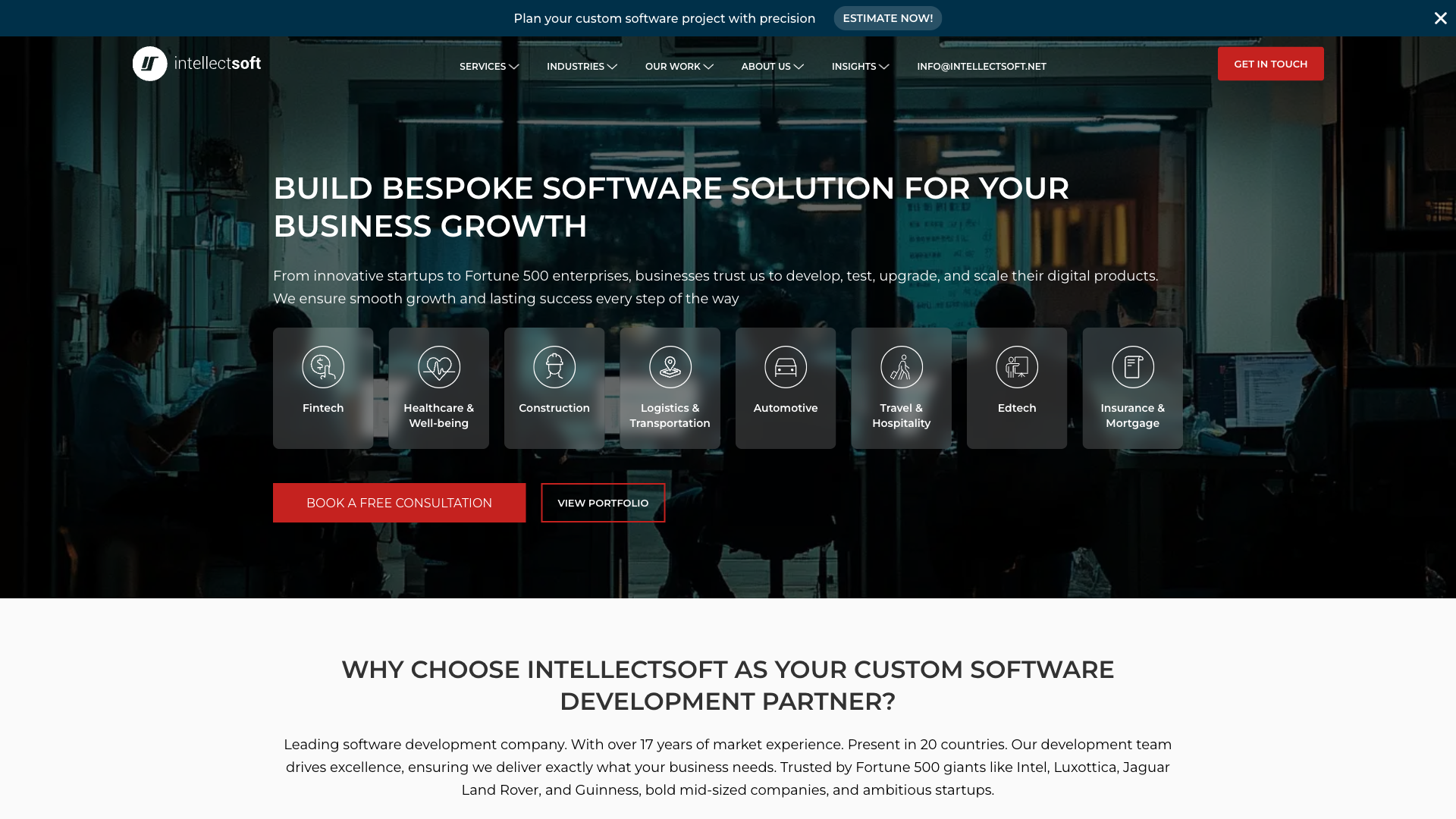
Overview: With 15+ years serving Fortune 500 companies and innovative startups, Intellectsoft has established itself as a leader in digital transformation and enterprise software development.
Key Stats:
- Founded: 2007
- Team Size: 800 employees
- Headquarters: Palo Alto, CA (offices in New York, London, Oslo, Kyiv)
- Pricing: $113,000-$135,000 developer salaries (enterprise-level rates)
Specializations:
- Digital transformation and modernization
- Mobile app development (iOS, Android, cross-platform)
- Blockchain and cryptocurrency solutions
- Enterprise software architecture
- AI and machine learning integration
Industries Served: Healthcare, finance, retail, manufacturing, technology
Notable Clients:
- Universal Pictures
- Jaguar Motors
- Qualcomm
- Ernst & Young
- Clinique
- Bombardier
- London Stock Exchange
- Harley-Davidson
Why Choose Intellectsoft: Best for enterprises needing sophisticated digital transformation with proven Fortune 500 experience. Their work with Harley-Davidson (reducing build time from 21 days to 6 hours) demonstrates their ability to deliver transformational results.
2. BairesDev
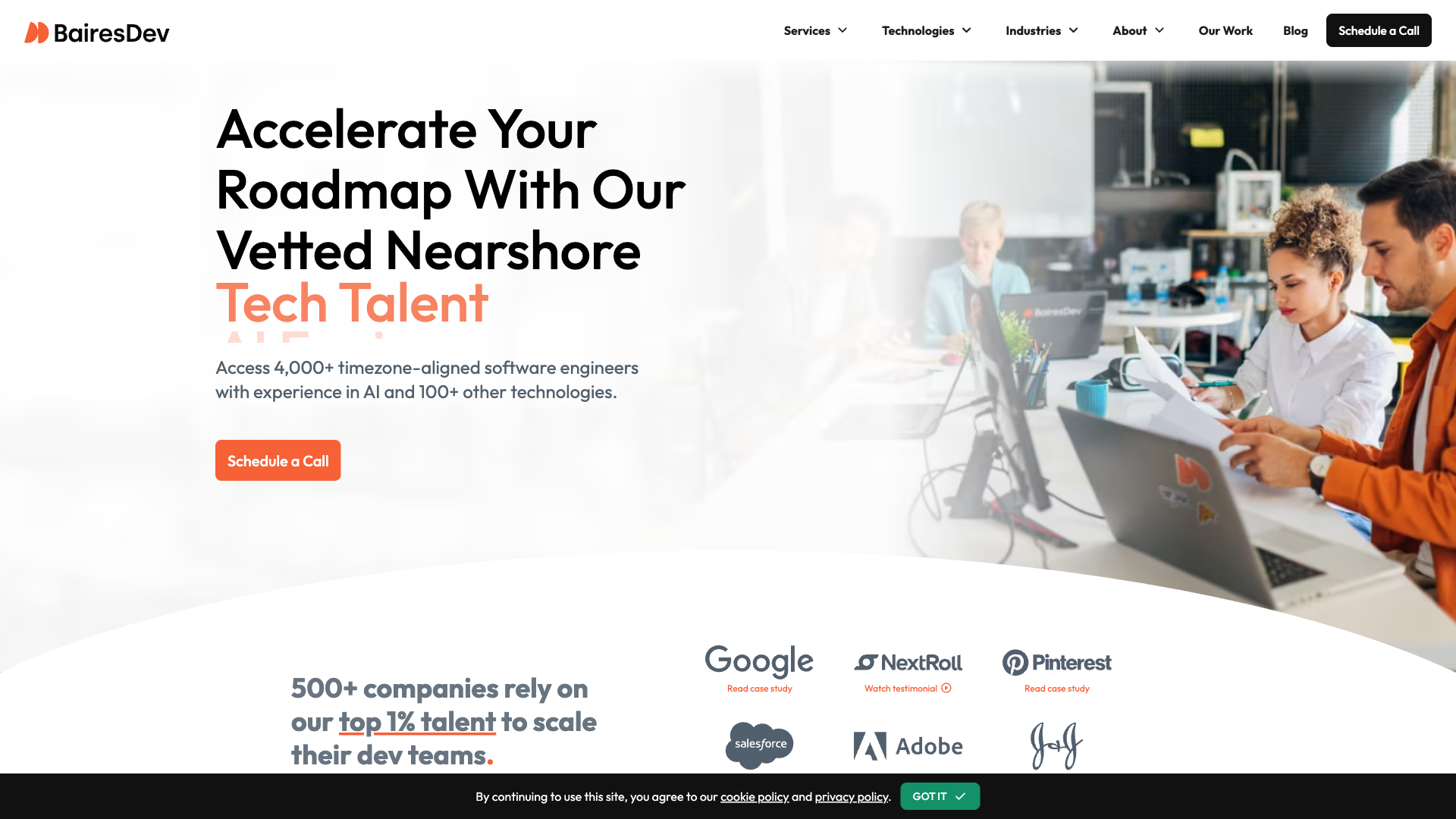
Overview: BairesDev operates a “Top 1%” talent recruitment model, selecting only the most skilled developers from Latin America to serve enterprise clients across the globe.
Key Stats:
- Founded: 2009
- Team Size: 4,000+ professionals across 600+ cities
- Headquarters: Latin America (expanding to US, Canada, UK)
- Growth: 383% YoY increase in ML expert requests (2024)
- Client Mix: 54% enterprise clients
Specializations:
- Nearshore software engineering
- AI and machine learning solutions
- Mobile application development (iOS, Android, cross-platform)
- UX/UI design services
- Cloud solutions and migration
- 100+ technologies and programming languages
Industries Served: 130+ industries including fintech, healthcare, retail, manufacturing, technology
Notable Clients:
- Adobe
- Johnson & Johnson
- Rolls-Royce
Why Choose BairesDev: Ideal for companies seeking top-tier nearshore talent with favorable time zone alignment. Their rigorous vetting process ensures you work with elite developers at competitive rates. The 383% increase in ML expert requests shows they’re at the forefront of AI development trends.
3. Simform
Overview: Simform ranked #3 globally and #1 in AI development on Clutch’s 2025 rankings, specializing in cloud-native development and performance engineering.
Key Stats:
- Founded: 2010
- Headquarters: San Francisco (delivery centers in India)
- Rating: 4.7/5 across 124 verified reviews
- Recognition: #3 globally, #1 AI Development (Clutch 2025)
Specializations:
- Cloud-native application development
- AI and machine learning engineering
- DevOps and CI/CD implementation
- Performance testing and optimization
- Microservices architecture
- API development and integration
Certifications:
- AWS Advanced Consulting Partner
- Microsoft Solutions Partner
- Google Cloud Partner
- CMMI Level 3
Industries Served: Retail, logistics, healthcare, high-tech, fintech
Notable Clients:
- Bank of America
- Twilio
- Red Bull
- Cisco
- Hyundai Glovis
- Fujifilm
Why Choose Simform: Best for companies prioritizing cloud-native architecture and AI integration. Their AWS Advanced Partnership and #1 AI Development ranking make them ideal for modern, scalable cloud applications.
4. Netguru
Overview: Netguru specializes in rapid MVP development, launching products within 12 weeks and helping startups validate ideas quickly.
Key Stats:
- Founded: 2008
- Team Size: 630+ developers and designers
- Headquarters: Poznań, Poland (offices in Warsaw, Kraków, Wrocław)
- Pricing: $70-150/hour
- MVP Timeline: 12 weeks to launch
- MVP Budget: $15,000-$150,000
Specializations:
- MVP (Minimum Viable Product) development
- Web and mobile application development
- AI and GenAI integration
- Product design and UX/UI
- Ruby on Rails development
- React and React Native
Industries Served: Fintech, healthcare, real estate, banking, SaaS startups
Why Choose Netguru: Perfect for startups and scale-ups needing rapid MVP development. Their 12-week launch timeline and proven track record make them ideal for validating product-market fit quickly. Budget-friendly pricing ($15K-$150K for MVPs) makes them accessible to early-stage companies.
5. ITechArt
Overview: ITechArt brings over 20 years of experience with a massive team of 3,500+ engineers, 70% of whom are senior developers.
Key Stats:
- Founded: 2002 (20+ years experience)
- Team Size: 3,500+ experienced engineers (70% Senior level)
- Headquarters: New York (20+ offices worldwide)
- Locations: USA, UK, Poland, Lithuania, Georgia, Armenia, Uzbekistan, Kazakhstan
- Fintech Expertise: Poland-based fintech center of excellence (launched 2022)
Specializations:
- Web and mobile application development
- Big Data and analytics solutions
- AI and machine learning
- QA and testing services
- DevOps and infrastructure
- Fintech solutions
Focus: VC-backed startups and fast-growing tech companies
Notable Clients:
- Oracle
- GAIN Capital (forex.com)
- Pfizer
- Kaspersky Lab
- O2 (Telefónica)
- Electronic Arts
- MongoDB
Why Choose ITechArt: Ideal for fast-growing tech companies and VC-backed startups needing senior-level expertise at scale. Their dedicated fintech center makes them particularly strong for financial services projects. The 70% senior developer ratio ensures experienced teams on every project.
6. ScienceSoft
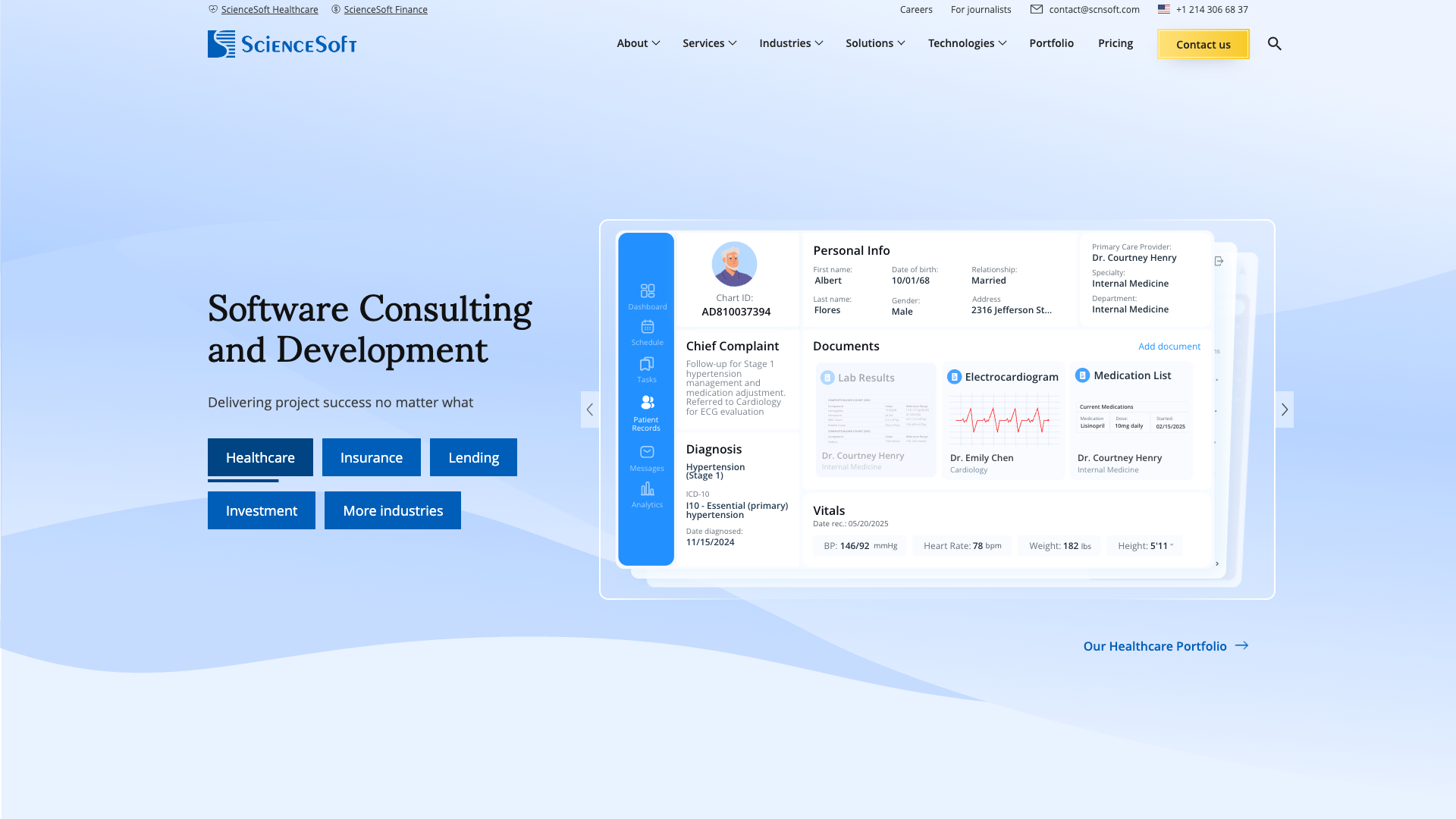
Overview: ScienceSoft brings 35 years of experience, making them one of the longest-established custom software development firms with deep expertise in healthcare IT and enterprise solutions.
Key Stats:
- Founded: 1989 (35+ years)
- Team Size: 750+ IT professionals
- Headquarters: US-headquartered with global delivery
- Pricing: $30-70/hour (competitive rates)
Specializations:
- Healthcare IT and medical software
- CRM solutions and customization
- Data analytics and BI
- Cloud development and migration
- Cybersecurity solutions
- Enterprise software modernization
Industries Served: Healthcare, banking, retail, manufacturing, telecommunications
Notable Clients:
- IBM
- eBay
- Robert Half
- Viber
- PerkinElmer
- Ford Motor Company
Recognition:
- Financial Times America’s Fastest-Growing Companies (4 consecutive years)
- IAOP’s 2025 Global Outsourcing 100 (4th consecutive year)
Why Choose ScienceSoft: Best for healthcare organizations and enterprises needing HIPAA-compliant, secure software. Their 35-year track record and competitive $30-70/hour pricing offer enterprise expertise at mid-market rates. Ideal for companies prioritizing stability and long-term partnerships.
7. Thoughtbot
Overview: Thoughtbot has built a reputation for software craftsmanship and engineering excellence over 20+ years, with 90%+ positive client feedback.
Key Stats:
- Founded: 2003 (20+ years)
- Team Size: 77-87 employees (lean, elite team)
- Headquarters: New York, NY
- Pricing: $150-250/hour (premium rates)
- Projects: 1,000+ clients served
- Satisfaction: 90%+ positive feedback
Specializations:
- Ruby on Rails development (experts in Rails ecosystem)
- React and React Native applications
- Software craftsmanship and clean code
- Agile development practices
- Code reviews and technical audits
- Developer training and workshops
Notable Clients:
- Pfizer
- Fandango
- American Family Insurance
- GrubHub
Why Choose Thoughtbot: Perfect for companies valuing code quality, engineering excellence, and long-term maintainability over speed. Their premium $150-250/hour rates reflect their exceptional craftsmanship. Best for projects where technical debt prevention is critical and you want senior-level engineers who follow best practices religiously.
8. Innowise
Overview: Innowise offers comprehensive digital transformation services with a focus on emerging technologies like AI, blockchain, and IoT.
Key Stats:
- Founded: 2007
- Team Size: 1,600+ IT professionals
- Headquarters: Poland (offices across Europe and US)
- Pricing: $25-49/hour (excellent value)
Specializations:
- Custom software development
- AI and machine learning solutions
- Blockchain development
- IoT and embedded systems
- Cloud solutions (AWS, Azure, Google Cloud)
- Mobile app development
- Quality assurance and testing
Industries Served: Healthcare, fintech, retail, logistics, manufacturing, energy
Certifications:
- ISO 9001:2015 (Quality Management)
- ISO 27001:2013 (Information Security)
- Microsoft Gold Partner
- AWS Select Consulting Partner
Why Choose Innowise: Ideal for mid-market companies seeking excellent value ($25-49/hour) with enterprise-grade quality and certifications. Their comprehensive service offering makes them a one-stop shop for digital transformation. Strong choice for companies exploring emerging technologies like AI, blockchain, or IoT.
How to Evaluate Custom Software Development Companies
Choosing the right development partner can make or break your project. Here’s your systematic evaluation framework:
1. Technical Expertise
What to assess:
- Proven expertise in your required technologies and frameworks
- Experience with emerging technologies (AI, cloud-native, microservices)
- Portfolio with at least 3 recent launches in your sector
- Quantitative outcomes in case studies (40% efficiency gain, 2x system stability)
How to verify:
- Review detailed case studies with technologies, duration, outcomes
- Conduct technical interviews with proposed team members
- Request practical assessments with real problem sets
- Check participation in hackathons, open-source contributions, tech conferences
2. Portfolio and Track Record
What to look for:
- Business results, not just technical implementations
- Client testimonials with specific outcomes
- Similar project experience (industry, scale, complexity)
- Long-term client relationships (indicates quality and trust)
Red flags:
- Generic, vague case studies without specifics
- No verifiable client references
- Claims without evidence or metrics
- Portfolio of only small projects if you need enterprise scale
3. Communication and Collaboration
Critical questions:
- What are your communication protocols?
- How frequently will we receive updates?
- Who is our primary point of contact?
- What tools do you use for project management?
- How do you handle time zone differences?
What to evaluate:
- Responsiveness during sales process (indicator of future communication)
- Clarity of documentation and proposals
- Proactive communication style
- English proficiency (if applicable)
4. Security and Compliance
Essential certifications:
- ISO 27001 (Information Security)
- SOC 2 (Security and availability)
- HIPAA (for healthcare projects)
- GDPR compliance (for EU data)
- Industry-specific certifications
Security practices to verify:
- Data encryption standards
- Secure development lifecycle
- Penetration testing protocols
- Incident response procedures
- NDA and IP protection agreements
5. Industry-Specific Expertise
Different industries have unique challenges:
- Healthcare: HIPAA compliance, HL7/FHIR integration, telemedicine regulations
- FinTech: PCI DSS, KYC/AML compliance, security-first architecture
- E-commerce: PCI compliance, high-traffic handling, payment gateway integration
- SaaS: Multi-tenancy, scalability, subscription management
Verification: Look for companies with dedicated industry practices or centers of excellence (like ITechArt’s fintech center).
6. Ratings and Reviews
Where to check:
- Clutch (most reliable for B2B software)
- GoodFirms
- Google Reviews
- G2
Benchmarks:
- Minimum 20 positive reviews on Clutch
- Overall score of 4.7 or higher
- Recent reviews (within last 12 months)
- Detailed feedback, not just ratings
Pricing Models Explained
Understanding pricing models helps you budget accurately and choose the right structure for your project.
Average Market Rates (2025)
- Budget-Friendly: $25-49/hour (39% of companies)
- Mid-Market: $50-99/hour
- Premium: $100-199/hour
- Enterprise/Boutique: $200-400+/hour
Geographic variations:
- Eastern Europe: $30-80/hour
- Latin America: $40-90/hour
- Western Europe: $80-150/hour
- US-based: $100-250+/hour
1. Fixed Price Model
How it works: Project scope, timelines, and costs agreed upfront. Client pays fixed amount for clearly defined deliverable.
Best for:
- Short-term projects with well-defined requirements
- Limited scope changes expected
- Clear deliverables (e.g., specific feature additions)
- Budget constraints requiring cost certainty
Pros:
- Predictable costs
- No surprise expenses
- Clear expectations
Cons:
- Requires detailed upfront planning
- Scope changes expensive
- Less flexibility during development
Typical use cases: Landing pages, website redesigns, specific feature additions, migrations.
2. Time & Materials (T&M)
How it works: Payment based on actual time spent (hourly or daily rates) by developers, designers, and team members.
Best for:
- Large-scale projects with many features
- Uncertain or evolving requirements
- Agile projects with iterative development
- Adequate budget without strict deadlines
Pros:
- Maximum flexibility
- Adapts to changing requirements
- Pay only for actual work
- Ideal for discovery and R&D
Cons:
- Unpredictable total costs
- Requires active oversight
- Potential for scope creep
Typical use cases: Complex web applications, enterprise software, AI/ML projects, product development with uncertain scope.
3. Dedicated Team Model
How it works: Client contracts team of experts working solely on their project. Regular payments (biweekly or monthly) based on team size.
Best for:
- Long-term projects (typically 18+ months)
- Requirements and scope may evolve
- Need for deep business understanding
- Integration with existing teams
Pros:
- Team deeply understands your business
- Seamless integration with internal processes
- Adopts your culture and methodologies
- Predetermined monthly budget
Cons:
- Higher monthly commitment
- Long-term contracts (usually 18 months minimum)
- Team size changes require negotiation
Typical use cases: Ongoing product development, digital transformation, large-scale enterprise applications.
4. Retainer Model
How it works: Fixed monthly cost for specified amount of work (e.g., 160 hours/month).
Best for:
- Ongoing development needs
- Long-term partnerships
- Continuous improvements and maintenance
- Predictable workload
Pros:
- Budget predictability
- Priority access to familiar developers
- No procurement hassles for each project
- Long-term cost savings
Cons:
- Unused hours may be lost
- Minimum monthly commitment
- Less flexibility than T&M
Typical use cases: SaaS ongoing development, continuous optimization, maintenance and support.
5. Hybrid/Milestone-Based
How it works: Combines fixed-price certainty for defined milestones with T&M flexibility between milestones.
Best for:
- Medium to long-term projects
- Need for stakeholder visibility
- Balance between predictability and flexibility
Pros:
- Balanced risk distribution
- Clear progress markers
- Flexibility within phases
- Stakeholder confidence through milestones
Cons:
- More complex contract structure
- Requires careful milestone definition
- Potential for disputes at milestone gates
Common Mistakes When Hiring (And How to Avoid Them)
1. Focusing Solely on Cost
The mistake: Selecting the cheapest option without considering quality, expertise, or long-term costs.
Why it backfires: Lower rates often mean junior developers, communication issues, or hidden costs that emerge later. A $30/hour team taking 500 hours costs more than a $150/hour team completing the same work in 80 hours.
The solution: Evaluate total cost of ownership: development + bugs + rework + opportunity cost. Compare value, not just hourly rates.
2. Ignoring Communication Red Flags
The mistake: Overlooking poor communication during the sales process, assuming it will improve later.
Why it backfires: Communication issues during hiring indicate substantial problems during development. You’ll face misaligned expectations, missed requirements, and frustrating project management.
The solution: Evaluate responsiveness, clarity, and proactivity during sales. If communication is difficult now, it will be worse when you’re dealing with technical issues under deadlines.
3. Skipping Technical Verification
The mistake: Accepting portfolio claims and marketing materials without verifying technical capabilities.
Why it backfires: Companies may showcase client work they only partially contributed to, or claim expertise they don’t actually possess.
The solution:
- Conduct technical interviews with proposed team members
- Request practical assessments with real problem sets
- Speak with past clients about technical execution
- Verify specific roles in portfolio projects (primary developer vs. minor contributor)
4. Underestimating Project Complexity
The mistake: Assuming your project is “simple” or “just like [existing app]” without proper analysis.
Why it backfires: Leads to unrealistic budgets and timelines. Discovering true complexity mid-project causes cost overruns, delays, and compromised quality.
The solution: Invest in proper discovery phase. Experienced partners should challenge your assumptions and help you understand true complexity before committing to fixed budgets or timelines.
5. Neglecting IP and Contract Terms
The mistake: Not clarifying intellectual property ownership, NDA terms, or contract exit clauses upfront.
Why it backfires: Disputes over code ownership, inability to switch vendors, or discovering you don’t actually own the software you paid for.
The solution:
- Ensure contracts specify IP transfers to you upon completion
- Sign mutual NDAs before sharing sensitive information
- Clarify what happens if you need to terminate early
- Understand escrow arrangements for source code
6. Ignoring Post-Launch Support
The mistake: Focusing solely on initial development without planning for maintenance, updates, and support.
Why it backfairs: Software requires ongoing maintenance, security updates, and bug fixes. Launching without support plans leads to security risks, downtime, and degraded user experience.
The solution:
- Discuss post-launch support during vendor selection
- Clarify response times for different severity levels
- Understand ongoing maintenance costs
- Establish SLAs for bug fixes and updates
Technology Stacks in 2025
Understanding which technologies leading companies use helps you make informed decisions about your own project.
Full-Stack Web Development
MERN Stack (MongoDB, Express.js, React, Node.js)
- Why it’s popular: JavaScript across entire stack, strong community, React Native compatibility for future mobile apps
- Best for: Scalable web applications, startups planning mobile expansion, real-time applications
- Who uses it: 70% of clients eventually add mobile apps—MERN offers seamless React Native integration
MEAN Stack (MongoDB, Express.js, Angular, Node.js)
- Why it’s popular: Better structure than MERN for complex applications, TypeScript integration
- Best for: Enterprise applications requiring strict typing, complex business logic
- Who uses it: Large organizations preferring Angular’s opinionated structure
AI/ML Development
Python Dominance
- Why it’s winning: Best libraries (TensorFlow, PyTorch), largest AI community, easiest ML model integration
- Best for: AI-first applications, machine learning, data science, backend services
- Frameworks: Django (full-featured), Flask (lightweight), FastAPI (modern async)
AI-First Stack Components:
- Python
- LangChain (LLM orchestration)
- OpenAI/Anthropic APIs
- Vector databases (Pinecone, FAISS)
- Designed for applications heavily relying on AI/ML
Mobile Development
Cross-Platform (70% adoption rate)
- Flutter: Dominating cross-platform development, excellent performance
- React Native: Continuing to dominate, huge ecosystem, JavaScript familiarity
Native Development (when performance is critical)
- Swift: iOS-specific, best performance for Apple devices
- Kotlin: Android-specific, modern language features
Decision factors:
- Cross-platform: Faster development, single codebase, 70-80% cost savings
- Native: Better performance, access to latest platform features, superior UX
Enterprise Stacks
Java with Spring Boot
- Why enterprises choose it: Efficiently manages complex business logic, large-scale operations, mature ecosystem
- Best for: Banking, insurance, large-scale enterprise applications
- Cost factor: Higher developer salaries due to demand and complexity
.NET (C#)
- Why enterprises choose it: Microsoft ecosystem integration, Azure synergy, excellent for Windows-centric environments
- Best for: Enterprise Windows applications, Microsoft shops, complex business logic
- Cost factor: Similar to Java in terms of developer expertise costs
Cloud-Native Development
Containers and Orchestration:
- Docker: Standard for containerization
- Kubernetes: Orchestration for production deployments
- Impact: 75% of enterprise applications will be cloud-native by end of 2025
Serverless Architectures:
- AWS Lambda, Azure Functions, Google Cloud Functions
- Benefits: Lower infrastructure costs by up to 70% for variable traffic applications
- Best for: Event-driven architectures, APIs, microservices
Use Cases by Business Type
Different business types have different software development needs. Here’s how to match your type with the right approach:
Startups: Speed and Validation
Primary needs:
- Get to market quickly with MVP (Minimum Viable Product)
- Validate product-market fit before major investment
- Maintain flexibility to pivot based on feedback
- Budget-conscious development
Recommended approach:
- Best partners: Netguru (12-week MVP), ITechArt (VC-backed startup focus)
- Pricing model: Time & Materials or Milestone-based
- Technology: MERN stack for web, React Native for mobile, cloud-native from day one
- Timeline: 8-12 weeks for MVP
- Budget: $15,000-$60,000 for initial MVP
Success factors:
- Partner experienced with lean startup methodology
- Agile teams comfortable with rapid iteration
- Focus on core features only (ruthless prioritization)
- Plan for scalability but don’t over-engineer
Example use case: A fintech startup needs to validate a new peer-to-peer payment concept. They partner with Netguru for a 12-week MVP development at $50,000. Within 3 months, they have a working product with 100 beta users, allowing them to raise their seed round based on real traction.
Mid-Market Companies: Balance and Growth
Primary needs:
- Modernize legacy systems without business disruption
- Integrate new software with existing processes
- Maintain cost-consciousness while ensuring quality
- Support growth without enterprise-level complexity
Recommended approach:
- Best partners: Innowise (excellent value), ScienceSoft (enterprise expertise at mid-market rates), BairesDev (nearshore quality)
- Pricing model: Dedicated Team or T&M with monthly budgets
- Technology: Modern stacks compatible with existing systems, cloud migration paths
- Timeline: 4-6 months for substantial projects
- Budget: $60,000-$250,000 depending on scope
Success factors:
- Phased implementation to manage risk
- Clear integration requirements upfront
- Regular stakeholder communication
- Focus on ROI and efficiency gains
Example use case: A 200-employee manufacturing company needs custom ERP to replace aging systems. They partner with ScienceSoft at $50/hour for a 6-month dedicated team project ($200K total). The phased rollout allows training and adjustment, achieving 25% efficiency gains within first year.
Enterprises: Scale and Compliance
Primary needs:
- Enterprise-scale complexity (thousands of users, massive data volumes)
- Stringent security and compliance requirements
- Integration with multiple legacy systems
- Long-term support and maintenance
- Formal governance and risk management
Recommended approach:
- Best partners: Intellectsoft (Fortune 500 experience), BairesDev (enterprise focus—54% of clients), ITechArt (3,500+ engineers)
- Pricing model: Dedicated Team with long-term contracts (18-24 months)
- Technology: Enterprise stacks (Java/Spring Boot, .NET), microservices, cloud-native
- Timeline: 9-18 months for major initiatives
- Budget: $500,000-$5,000,000+ depending on scope
Success factors:
- Formal security certifications (ISO 27001, SOC 2 Type II)
- Proven enterprise methodology
- Dedicated account management
- Comprehensive documentation
- Change management support
Example use case: A Fortune 500 insurance company needs to modernize claims processing across 50 states. They partner with Intellectsoft for an 18-month enterprise transformation at $2.5M. The resulting system handles 100,000+ daily transactions, achieves 40% faster claim processing, and maintains SOC 2 compliance.
The Future of Custom Software Development
Understanding emerging trends helps you future-proof your technology investments.
AI Integration Everywhere
Current state: Nearly 50% of developers now integrate AI assistants (GitHub Copilot, OpenAI Codex) into daily coding. AI is transforming design, development, and deployment.
2025 trends:
- AI-assisted prototyping is standard in MVP development
- AI-driven user analytics understand behavior automatically
- Machine learning requests increased 383% year-over-year (BairesDev data)
- AI-powered testing generates test cases automatically
Business impact: Companies integrating AI into custom software see 30-50% productivity gains in specific workflows. Healthcare providers using AI-assisted diagnosis tools report 25% faster patient processing.
Low-Code/No-Code Platforms
Market growth: The low-code/no-code market will reach $187 billion by end of 2025, growing at 31% annually.
What it means:
- Product teams launch testable MVPs in days instead of months
- Reduced dependency on developers for simple applications
- Faster time to market for standard workflows
Impact on custom development: Low-code handles commodity features; custom development focuses on true competitive advantages. Smart companies use hybrid approaches: low-code for admin panels, custom code for core IP.
Cloud-Native by Default
Adoption statistics: By end of 2025, 75% of all enterprise applications will be cloud-native (containerized, microservices-based, IaC-managed).
Benefits realized:
- Lower infrastructure costs by up to 70% for variable traffic
- Improved scalability and resilience
- Faster deployment cycles
- Better disaster recovery
Technology implications:
- Docker and Kubernetes are table stakes
- Serverless for event-driven workloads
- Multi-cloud strategies for vendor independence
Edge Computing and Real-Time Processing
Why it matters: Real-time processing is no longer futuristic—it’s a necessity. Applications deployed closer to where data is generated enable:
- Real-time analytics
- AR/VR experiences
- Autonomous systems
- IoT device coordination
Industry applications:
- Healthcare: Portable diagnostic devices for continuous patient monitoring
- Manufacturing: AI-powered cameras for quality control, reducing defect rates
- Retail: In-store analytics and personalized experiences
- Logistics: Real-time route optimization
Challenges: Distributed edge systems are harder to secure. Zero-trust security models recommended for edge deployments.
Microservices Becoming Standard
Key advantages:
- Break applications into smaller, independent services
- Teams deploy updates faster without affecting entire system
- Independent scaling of components based on demand
- Better fault isolation
Containerization synergy: Containerized applications provide lightweight, portable execution frameworks for microservices, delivering applications consistently across diverse hardware.
Questions to Ask Before Hiring
Use these questions during vendor evaluation to make informed decisions:
Discovery and Requirements
-
How do you conduct discovery workshops? Understand their process for capturing requirements and identifying improvement opportunities.
-
Who from our team needs involvement during discovery? Clarifies stakeholder time commitments upfront.
-
How do you ensure requirements are accurately captured? Look for structured approaches like user story mapping, prototyping, or formal requirements documentation.
-
What’s your process for managing scope changes? Understand how they handle inevitable requirement evolution.
Communication and Collaboration
-
What communication tools do you use? (Slack, Teams, email, project management platforms)
-
How often can we expect updates? Daily standups? Weekly reports? Real-time access to progress?
-
Who will be our primary point of contact? Ensure you have a dedicated person, not rotating contacts.
-
What are your escalation procedures for issues? Know how problems get resolved quickly.
-
How do you handle time zone differences? Critical for offshore/nearshore partnerships.
Technical Capabilities
-
Do you have experience with our required tech stack? Verify specific framework and tool expertise.
-
How do you stay current with emerging technologies? Look for continuous learning culture.
-
What is your approach to technical debt? Understand how they balance speed vs. code quality.
-
What testing protocols do you follow? Automated testing? Manual QA? Performance testing?
Intellectual Property and Legal
-
Who owns the IP once the project is completed? Critical—ensure IP transfers to you upon completion.
-
Will you sign an NDA? Protect your confidential information with legally binding agreements.
-
What happens to the source code if we terminate early? Understand escrow arrangements and code ownership.
Post-Launch Support
-
Will you provide post-launch support? For how long? Launching is just the beginning—software needs ongoing maintenance.
-
What’s covered under support? Bug fixes? Security updates? Feature requests?
-
What are response times for different severity levels? Critical bugs vs. minor issues need different SLAs.
-
How do you handle ongoing maintenance? Retainer? T&M? Separate contracts?
Pricing and Budget
-
What pricing model do you recommend for our project? Fixed, T&M, dedicated team, hybrid?
-
What’s included in the quoted price? Project management? QA? DevOps? Deployment?
-
Are there additional costs we should anticipate? Third-party licenses? Cloud infrastructure? Support?
-
How do you handle budget overruns? Clear processes prevent surprise invoices.
Credentials and References
-
Can you provide client references for similar projects? Speak with past clients about technical execution, communication, and outcomes.
-
What certifications do you hold? ISO 27001, SOC 2, HIPAA, GDPR compliance?
-
Can you share detailed case studies? Look for quantitative outcomes, not just technical descriptions.
Making Your Decision: A Framework
Here’s a systematic approach to choosing your custom software development partner:
Step 1: Define Your Must-Haves (30 minutes)
List non-negotiable requirements:
- Budget constraints (maximum you can spend)
- Timeline requirements (launch date or duration)
- Technical requirements (specific technologies, integrations)
- Compliance needs (HIPAA, SOC 2, GDPR, etc.)
- Geographic preferences (time zones, language)
Step 2: Identify Strong Preferences (15 minutes)
List important but not deal-breaking factors:
- Preferred pricing model
- Team size preferences
- Industry experience
- Specific methodologies (Agile, DevOps)
- Company size and stability
Step 3: Shortlist Companies (1-2 hours)
Based on this article and additional research:
- Identify 3-5 companies meeting all must-haves
- Score them on strong preferences
- Check ratings on Clutch, GoodFirms (minimum 4.7/5, 20+ reviews)
Step 4: Initial Conversations (1 week)
Schedule calls with shortlisted companies:
- Explain your project and requirements
- Ask discovery questions from previous section
- Assess communication quality and responsiveness
- Request proposals with detailed estimates
Step 5: Evaluate Proposals (2-3 days)
Compare proposals on:
- Total cost (not just hourly rates)
- Timeline realism
- Team composition and experience
- Proposed technology stack
- Risk mitigation approaches
- Contract terms and IP ownership
Step 6: Technical Validation (1 week)
For finalists:
- Conduct technical interviews with proposed team members
- Request practical assessment with sample problem
- Speak with 2-3 client references
- Verify certifications and credentials
Step 7: Make the Decision (1-2 days)
Choose based on:
- Best value (not cheapest, but best ROI)
- Technical expertise for your specific needs
- Communication and cultural fit
- Contract terms and flexibility
Total time investment: 2-3 weeks for thorough evaluation. Rushing this process costs far more in project failures or poor outcomes.
Conclusion: Your Path Forward
Custom software development can transform your business—reducing costs by 20-30%, achieving ROI in 12 months, and providing competitive advantages impossible with off-the-shelf solutions.
Key takeaways:
-
Match company to your business type: Startups need MVP specialists like Netguru. Enterprises need proven partners like Intellectsoft or BairesDev.
-
Don’t compete on price alone: A $150/hour team finishing in 80 hours costs less than a $30/hour team taking 500 hours—and delivers better results.
-
Verify technical capabilities: Portfolio claims mean nothing without technical interviews, practical assessments, and reference calls.
-
Clarify IP ownership upfront: Ensure contracts specify complete IP transfer to you upon completion.
-
Plan for post-launch: Software needs ongoing maintenance, security updates, and support. Choose partners offering long-term relationships.
-
Future-proof your stack: Prioritize cloud-native, AI-ready, scalable architectures that evolve with your business.
Next steps:
- Define your requirements using the framework in this article (1-2 hours)
- Shortlist 3-5 companies based on your business type and needs (2-3 hours)
- Schedule discovery calls with shortlisted firms (1 week)
- Conduct technical validation for finalists (1 week)
- Make your decision and begin partnership (1-2 days)
The custom software development market is growing at 22% annually because companies realize that competitive advantages come from unique solutions, not commodity software. The right development partner doesn’t just build software—they become a strategic asset that enables your business to move faster, operate more efficiently, and deliver better experiences than competitors.
Start your evaluation today. The companies profiled in this article represent the best the industry offers in 2025—each excelling in different areas. Your perfect partner is among them.
Ready to start your custom software project? Use the evaluation framework in this article to systematically assess development partners, verify their claims, and make a confident, data-driven decision within 2-3 weeks.